Have you ever wondered how to create a schedule for hybrid events? Combining in-person and virtual elements in your event’s activities is what will make the difference for your success.
That’s because what makes a hybrid event memorable is mainly technology and shared experiences, even across different (physical and virtual) spaces.
So building a schedule for this type of event is a responsibility that requires some care and a search for innovative solutions.
With that in mind, I put together this complete article for you to learn the basic concepts, see examples, and create your own schedule. Check it out below:
- Why is a well-structured schedule important?
- How to create a schedule;
- Example of a schedule for hybrid events;
- How to expand your event’s presence.
Why is a well-structured schedule important?
If you’ve decided to organize a hybrid event, you certainly know your mission is to bring the in-person and virtual experiences together in the best way possible.
So you need to invest in your event’s hybrid schedule! That’s because it’s there that the audiences come together or stay separate.
As a good organizer, you should know when to offer a shared experience for everyone and when it’s possible to include activities specific to each audience.
Also, with a well-structured schedule you can:
- Generate value for the event;
- Create more space for sponsors;
- Promote actions specific to each audience;
- Enable unique experiences;
- Know exactly which technologies and solutions are needed to engage your attendees.
How to create a schedule for hybrid events?
To start, it’s important that you’ve already defined a few basic items for holding a hybrid event, such as:
- Speakers;
- Event venue;
- Broadcast formats;
- Equipment (lighting, microphones, cameras, screens, etc.);
This will be your foundation for creating a schedule for hybrid events, and it will support you when thinking of more engaging activities.
1. Define the structure of your hybrid event
As we know, a hybrid event needs to bring together online and in-person audiences in its experience.
But to do that, some decisions need to be made, such as the format of your activities and how they’ll work in practice.
That is, it’s time to map out the equipment you need, run tests, and check the venue’s setup…
Since there are so many options, you should look at each of your event’s activities individually, deciding what’s possible to do and how you can offer the most shared experience.
For example, live broadcasts of talks are quite common at hybrid events. However, you need to pay attention to the structure of this type of activity, mapping out questions such as:
- Does this activity make sense/will it be appealing to my audience?
- What equipment is needed? Does it fit my budget? Can I use it?
- Do both the physical and in-person spaces have the infrastructure for this?
- Is my speaker prepared for this activity? How can I prepare them?
Finally, remember: your event doesn’t need to be completely split between in-person and online, but it will become much more interesting if it offers more opportunities for engagement between the audiences.
2. Offer an impactful experience for both audiences
Even though there may be exclusive activities for each audience at certain times, the hybrid event still needs to work for everyone.
So you need to create a strategy so both audiences feel included in the schedule, even if in different formats.
Some activity tips are:
- Try live-streaming an in-person talk, or vice versa. This way, you can use the online chat to answer questions and bring the audiences together;
- Your in-person content can be recorded, edited, and made available on an online platform as extra content, and can even be sold later;
- Create digital conference rooms where online attendees can network, just like the in-person audience;
- Offer engagement opportunities by creating virtual communities;
- Use gamification strategies;
- Invest in technologies specifically designed to engage virtual attendees, such as reactions, applause, and targeted messages;
- After the event, promote other in-person meetups with attendees from the same city.
In short, when creating a schedule for hybrid events, meaningful content, memorable experiences, and always-available support make all the difference!
Example of a schedule for hybrid events
Now that your schedule is complete, when structuring your activity grid, it’s a good idea to make the key information clear for everyone at the event.
Make the day, time, talk name, speaker name, and the platform each activity will be streamed on explicit.
It’s also important to specify information about in-person activities, such as the activity name, the person responsible, and the room or stage.
So let’s look at an example of how your hybrid schedule can be displayed, splitting the grid by the items mentioned above. Check it out:
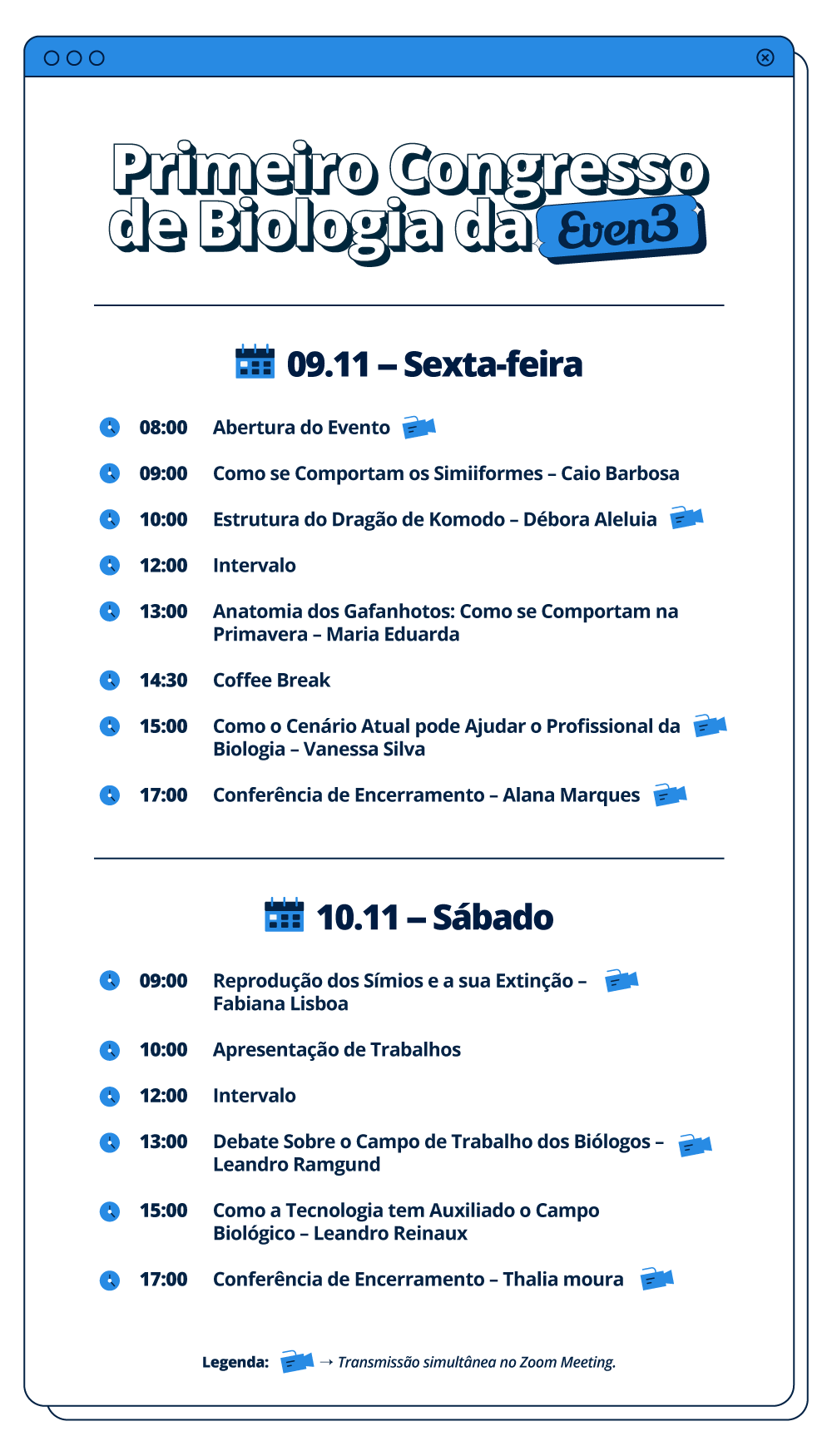
It’s worth noting that for each talk or activity, I made a point of displaying the speakers.
That’s because this is a detail that adds value to the schedule, especially if one of your speakers is well known in their field.
Also, did you notice that in the schedule I added tags indicating the in-person and online sessions? I structured it this way so it’s clear to attendees where each talk will take place, making the grid easier to read.
How to expand your hybrid event’s presence
Creating a schedule for hybrid events can become much easier when you use an events platform, like Even3.
This ease comes from the wide variety of tools a platform like this can offer.
On Even3, you can send emails to all your attendees and send certificates in bulk, just like other successful events that have used the platform.
And of course, you also get an exclusive website for your event, with a space dedicated solely to promoting your schedule.