In 2021, Even3 saw a 350% increase in the number of online events held on the platform. Can you imagine receiving that many events in one year?
That increase was certainly tied to the social changes and restrictions of the Covid-19 pandemic.
However, even after the pandemic, 96% of marketing professionals are betting on online events sticking around, according to research from Bizzabo.
In other words, digital arrived in full force in the world of events! And are you up to date on the new technologies?
Today I’ll give you a complete step-by-step on how to organize online events and everything you need to know to get started now.
See more:
- What are online events?
- Advantages of holding online events
- How to plan an online event
- Post-event: what to do?
- How to promote an online event
What are online events?
An event is any occasion with specific purposes, organized by people specialized in a given subject.
And that applies to online events too, the only difference being the location where the event is held, moving from in-person to virtual.
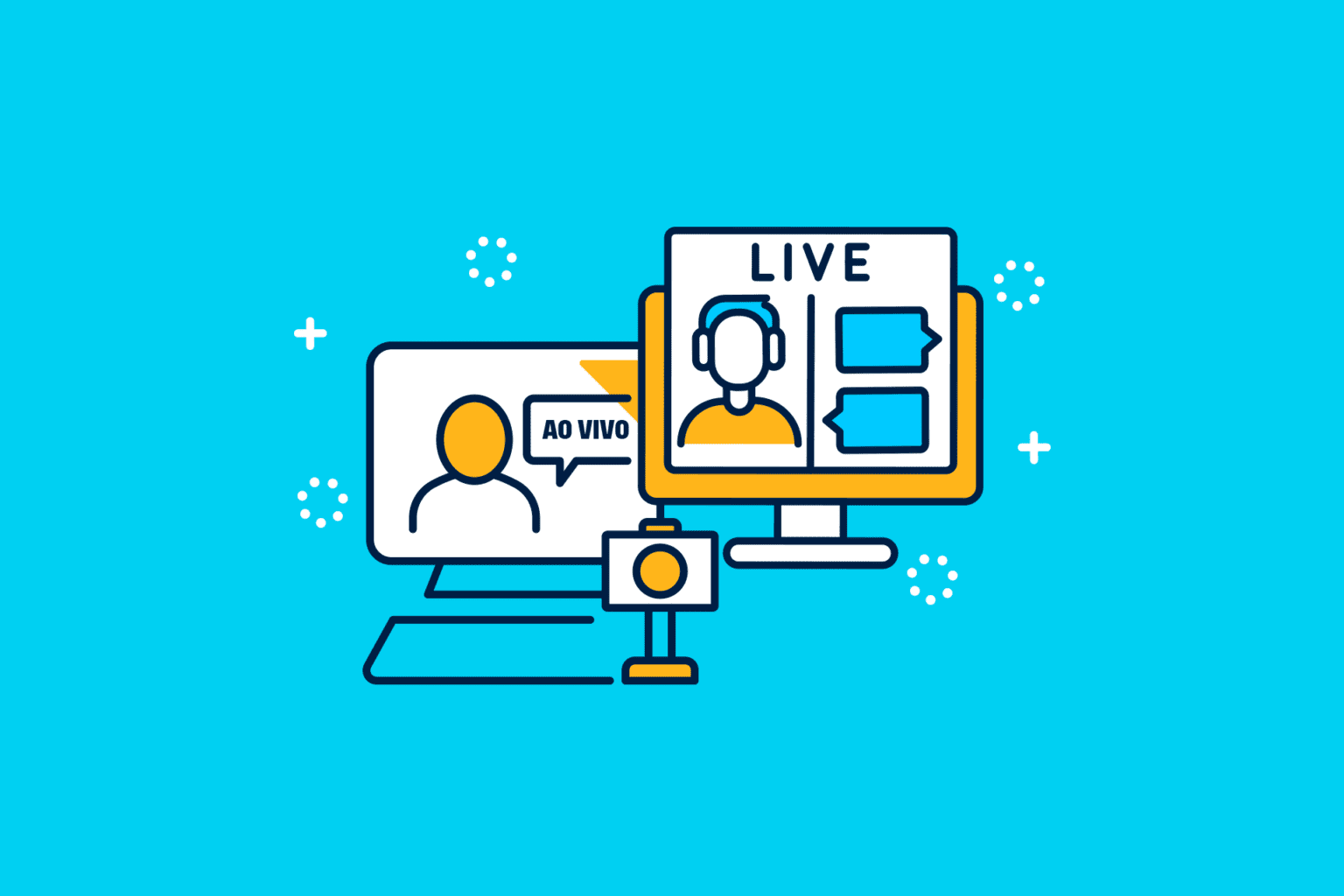
So, online events are events that happen in the digital environment, and can be streamed online on social media or on a platform specialized in streaming online events.
In fact, this format has grown quite a bit in Brazil, where there’s a very sizable audience to consume it.
A Video Viewers survey, commissioned by Google and conducted by Provokers, showed that 95% of Brazilians regularly watch online videos.
Over five years, that growth was 165%, while TV consumption grew only 25%.
Advantages of holding online events
Reach a bigger audience
Have you ever stopped to think that an online event can have international scale? After all, anyone, from anywhere in the world, can attend your event.
This way, you can pair that advantage with good promotion in the right channels and, organically, reach a sizable audience.
For example, by using YouTube to stream your online event, attendees can share your live on other channels and, as a result, attract more people to your online event.
And that’s great! Especially if you want to build up your own image or a company’s brand, since you’ll be gaining visibility at no cost at all.
Low investment cost
Since it’s an online event, you can cut costs quite significantly, since you won’t have expenses with venue rental, coffee breaks, flights, and lodging for speakers, and much more.
So, compared to in-person events, organizing an online event ends up much cheaper!
Because, in theory, you only need a laptop with a built-in camera and microphone.
Also, social networks like Facebook, YouTube, and Instagram are heavily encouraging this format, making it easy and quick to stream video online.
Convenience and flexibility
Organizing an online event brings convenience both for the organizer and for the audience watching the stream.
Some common conveniences are:
- Watching the event from wherever you are, using any electronic device connected to the internet;
- More democratic accessibility, since all you need is a phone and headphones;
- Content can be made available after the event, free or not;
- Organizers can choose to stream a recorded event and produce it whenever they want;
- Event platforms, like Even3, can automate much of the event, like check-in and certificate delivery.
Strengthens your business’s branding
Many companies use online events to strengthen their branding. But do you know what that means?
“Branding is a set of actions that build a brand according to its positioning, purpose, and values.” Izabel Barbosa, branding specialist and speaker at Even3 Summit 2021
In other words, branding seeks to create a personality or convey a lifestyle to attract people who identify with what you’re communicating.
In this case, online events are a bridge of communication with your audience!
So, they can help you become a reference in your niche and gain more visibility and credibility.
How to plan an online event in 6 steps
First off, it’s important to keep in mind that organizing an online event is different from putting on an in-person one.
For that reason, we put together a free, complete manual to help you with every step. Take advantage of it:
In short, you should follow these main steps:
1. Think of a theme
- What subject will you cover?
- What is your audience interested in learning?
- Is it a relevant, current topic?
These are some questions you should ask before settling on the theme that’ll be your event’s focus. After all, everything revolves around it.
If you don’t know where to start, one option is to ask your audience directly. You can use social media polls or even a form shared through strategic channels.
Many organizers still don’t realize it, but the theme can define whether an online event succeeds. After all, it’s what attracts attendees to your event.
So, get to know your audience to settle on a good theme!
2. Set a date and time
Now that you know the theme, it’s time to set a date and time.
It’s very important to define these details ahead of time so you can do better promotion of your online event in the digital space. Whether on social media, websites, or even ads on strategic channels.
When picking the date and time, it’s crucial to think about your event’s audience. So, ask questions like:
- Are they people with a lot of commitments?
- What’s their age range?
- Are they students? Or already graduated and working business hours?
Your audience will be your guide!
What’s the best day to hold an online event? Although that’s a very common question, it doesn’t have one right answer! That’s because every choice about the event should always consider your audience. Always think about them before deciding on theme, date, and time. These details are crucial for your event to happen and be a success! Still, watch out for holidays and long weekends, since turnout on those days tends to be lower. Even though your event is online and doesn’t require attendees to be physically present, they still need to set aside time to watch the stream.
3. Set aside the essential equipment
To hold a successful online event, you need to think beyond the content that’ll be covered. You need to think about audiovisual recording equipment, like:
- Camera;
- Microphone;
- Computer;
- Internet;
- An online streaming platform.
Having good equipment to record your stream is essential so the audio, image resolution, and internet connection all work properly and nothing goes wrong.
But you don’t have to be a professional to record this kind of event! Actually, a phone, a 4G connection, and headphones can already stream an event.
It all depends on your event and its size. How many people do you expect to watch your stream? Does your event have more than one speaker? Are there simultaneous activities or just one?
Whatever the answer, an events platform can help you automate many steps, like receiving registrations, streaming, and promoting the event.
In fact, see how easy it is to create an online event through an events platform: in just 5 steps you can secure your event’s online streaming and security!
4. Set your ticket price
Have you stopped to think about whether your online event will be free or paid? Well, this question is very important and fundamental for the next steps.
That’s because this decision will directly impact how you should organize your online event.
→ Learn how to price your event’s tickets
With a paid online event, you need to think about how to handle attendee registration and even manage sales.
And, for that, you need to use a platform that lets you manage both of those steps. After all, a paid event needs to be very complete and well planned.
This way, a platform like Even3 can help you manage the entire sales and registration cycle for attendees, as well as have a website, sell your tickets online, and much more!
However, if your online event is free, you should also choose to use an event management platform.
That’s because promoting free online events is an excellent way to generate leads for your business and significantly boost sales.
After all, by holding a free event you can attract far more attendees than with paid events, capturing name, email, and contact number.
This way, as long as you’re following data protection laws for events, an events platform will help you build a relationship through strategic channels, like email.
From there, you’ll be able to sell a product or service from your business to that contact base you acquired just by promoting a free online event. Pretty cool, right?
5. Length of the online event
You need to determine a duration for your online event!
The ideal is to not make it too short or too long, since attendees might start leaving your stream. And you don’t want that, right?
Typically, online event activities run 30 minutes to 1 hour on average.
But remember: don’t drag out a topic that’s already been fully covered. Try to be objective, direct, and encourage interactivity to hold attention.
6. Streaming online events: live, recorded, or videoconference?
Speaking of recording or live streaming, it’s important that you know your streaming options.
To pick the ideal format, your audience, the proposed theme, and the type of event will make all the difference. That’s because everything depends on how you want to deliver the content.
In this case, you have three options:
- Live streaming: In live mode, recording and streaming happen at the same time;
- Videoconference: Works like a digital meeting or a virtual classroom, with more control over who can join the stream;
- Recorded streaming: Consists of recording an event’s talks ahead of time.
Tools for streaming online events
YouTube Live
YouTube Live is a Google tool that lets you hold live events and stream them in real time on YouTube.
Since it’s quite popular, an event streamed on YouTube tends to attract a lot of people and be very interactive.
Advantages:
- Content can stay available to the audience afterward. In other words, whoever arrived late or missed the day of your event has a chance to watch it another time;
- The audience can interact with the event’s presenter in real time. It’s common for speakers to set aside time to answer questions and chat with the audience;
- Afterward, YouTube provides metrics and stats that can help with marketing strategies and promotion for your next event.
Zoom Meetings
There’s also Zoom Meetings, highly recommended for online videoconferences.
With it, you can hold a videoconference with up to 500 participants and 10,000 viewers, making it well suited even for large-scale events, since it’s a very robust platform.
Advantages:
- Unlike YouTube Live, Zoom lets attendees be split into groups during the videoconference;
- It also offers real-time chat, letting the moderator/speaker interact with attendees;
- Allows sharing of educational materials.
However, the free version has limits on two fronts: number of attendees and online event duration, capped at 40 minutes.
Even3 Streaming
Besides the most common types of online streaming, Even3 offers Even3 Streaming, a feature built specifically with your event’s streaming security in mind.
Advantages:
- Only registered attendees can access the stream;
- Has a link secure from sharing and intrusion;
- No risk of going offline;
- Comes with interactive tools, like chat, polls, giveaways, and much more.
Post-event: what to do?
Now that you know how to organize an online event, it’s time to find out what to do after your stream wraps up.
In this case, there’s one very important thing you can’t forget to do at the end of your online event: asking attendees for their opinion.
Running a satisfaction survey is essential at this stage.
After all, getting feedback from those who attended your online event, especially if it’s the first time you’re organizing one, can be the key to guaranteeing the success of future editions.
Also, don’t forget to share the results on your social media!
How to promote an online event
Since it happens in the virtual space, promotion is much more effective and low cost!
After all, in the digital space, everyone is connected at the same time and present across several channels, like: social media, email, websites, and so on. And you can use that to your advantage!
Your event needs a digital presence to be remembered. And, for that to happen, you’ll need to apply Digital Marketing strategies.
Social media
Always share content on social media to engage your audience and attract even more attendees to your online events. But how can you do that? It’s simple!
Give your audience useful, relevant content, like, for example, the next topic that’ll be covered in a future event or even topics already covered in past events.
Post short video clips of a topic already covered at an online event, or even comments from attendees who watched and had a positive experience.
With this kind of strategy, you not only generate value for your audience, but also become a reference in your field.
So, with social media, your message can reach your audience faster and reach thousands of people, boosting your online event’s visibility.
Beyond sharing content, social media should, above all, be used as a bridge for building a relationship with your audience. Interact! Answer questions and stay close to people at all times.
Email marketing
Another way to promote your online event is with email marketing!
With it, you can build a relationship with your audience directly and establish exclusive communication.
You can build a contact list as you keep producing online events. For example, start asking for name and email so people can attend your stream.
As you do that, your contact list keeps growing and you’ll be able to send email marketing about upcoming events, topics, satisfaction surveys, and much more.
But remember to follow Brazil’s data protection law, okay?
Want to learn more about email marketing and how it can boost your online event’s sales? Just download our free e-book:
Online ads
Also, you can invest in online ads!
Even though social media is free, advertising in the digital space is paid. You can, for example, create ads on Facebook, Instagram, LinkedIn, YouTube, and Google.
Online, you can target ads by gender, age, location, consumption habits, and behavior, among several other factors.
This way, you can reach exactly the ideal audience to attend your online event.
Now, you’re more than ready to organize an online event, choose the ideal tools and platform to stream it. Plus, of course, attract an audience with great promotion.