Now it’s time to talk about digital event organizers’ number one question: how do you check in attendees at an online event?
How can I check in my attendees? What tools should I use?
We know that a lot changes when moving from an in-person event to a digital one, and check-in is no exception.
In this article, I’ll walk you through a few approaches you can take to check in attendees at your digital event. All of them are pretty simple and accessible.
That said, some approaches require a bit more patience and time from organizers, since they’re done manually.
Either way, I’ll also cover even more practical solutions: the automated check-in options for online events.
How Have Organizers Been Handling Check-In at Digital Events?
Digital events have been around for a while, especially abroad. But it was the pandemic that quickly forced organizers everywhere to migrate from in-person to digital.
And what we’ve noticed is that online events are, in fact, here to stay. That’s why it’s important to think through how every stage of the event works in the digital format.
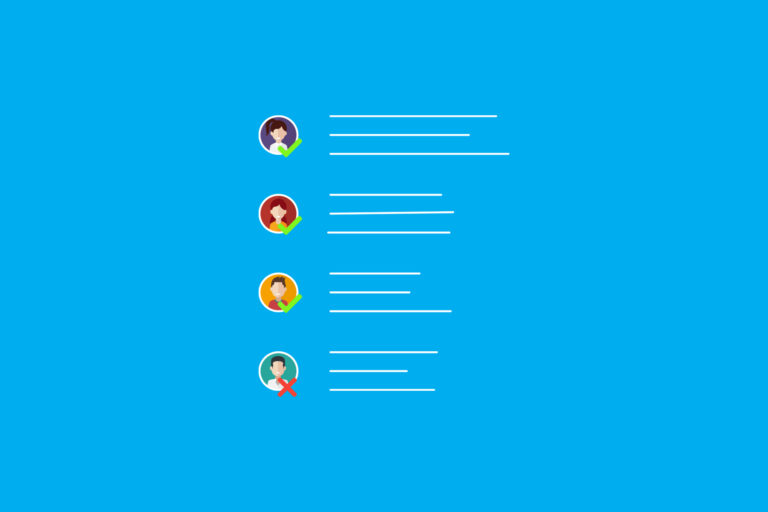
Check-in is a way to control attendee flow and also to confirm who actually attended, even digitally, the event and its activities.
Based on what we’ve observed, organizers have come up with a few different approaches to checking in attendees at the event and at each of its activities.
Check-In via Form
One of the most common ways to check in attendees at online events is through forms.
During the event broadcast — whether it’s a video conference, a live, or a recording — the organization shares a Google Forms or SurveyMonkey link so that attendees who are present during the broadcast can fill in their details. That’s how they confirm their attendance.
However, this is a pretty manual way to check in attendees. That’s because, afterward, the organization has to cross-check the event registration data against what was entered in the form.
Creating a form is quite simple. Just go to Google Forms or SurveyMonkey, create an account, and write questions that make sense for your event.
But, being realistic with you here… you know what happens? Most of the time, the data ends up inconsistent!
What do we mean by that?
To register for the event, an attendee might use one email address, and then use a different one when filling out the form.
Or they might write an incomplete name, misspell it, or use a different last name.
Imagine having to check each one, one by one, to make sure everything matches up. That takes quite a while. And the result is a handful (or a lot!) of emails from attendees asking about their certificate of participation.
By the way, we’ve already warned you: the topic of certificates tends to flood event organizers’ inboxes! But there are ways to avoid that, as we’ve explained in other articles on this blog.
On top of that, it’s common for the organization to receive emails from attendees claiming they watched the broadcast but couldn’t access the form, or that they missed the moment when the link was shared.
These are some of the situations that come up when check-in is done through a form.
When Does Form-Based Check-In Work Well?
Form-based check-in probably works best for small-scale events, with up to around 15 attendees or so.
In these cases, the speaker and the organization end up having much closer, easier contact with the audience.
In short: forms are indeed one option for check-in at online events, but they’re a more labor-intensive alternative for the organization.
You need to weigh whether it’s the best choice for your event. That said, we do not recommend it (seriously!) for large-scale events.
Check-In via Chat
Chat was another check-in method that became popular at online events.
In the events we’ve looked at, we’ve seen speakers ask attendees to leave details like their full name and email right in the broadcast chat, so a certificate could be sent to them.
This is also a highly manual way to check in attendees, and it comes with its own set of problems, such as:
- Sharing an attendee’s name and email with other registrants at the event
- Depending on how many people are registered for the activity, a high volume of chat messages
- A high volume of chat messages distracts attendees and gets in the way of collecting the information (name and email), as well as the space for questions and knowledge-sharing
- The chat isn’t always saved after the broadcast. Of course, that depends on the tool chosen to broadcast the event, so it’s worth checking on that ahead of time.
Check-In by Creating a Second Event
Yes, we’ve also seen some organizers check in attendees by creating a second event.
A bit confusing, right? Don’t worry, I’ll explain.
During the broadcast, the speaker or the organizing committee shares a link to a second event with attendees.
This second event is created solely for the purpose of checking in attendees.
Attendees then register for free for the second event, and once it’s over, the organizing committee checks the names and emails of everyone who registered.
Those are then considered checked-in attendees and, consequently, if the event’s rules call for it, eligible to receive a certificate of participation for the activity.
What’s the problem with this approach?
The information ends up completely scattered! And this commonly causes confusion for attendees.
After all, some might even think they actually attended two separate events. Imagine the confusion if one of them requests two certificates? That’s why we don’t recommend this approach.
How Even3 Simplified Check-In at Online Events
After listening to our organizers and gathering feedback on the topic, we made improvements to our online event check-in system.
Now, Even3 offers organizers the chance to check in attendees at digital events in two different ways: automatic and manual.
Automatic Check-In
With automatic check-in, the attendee is checked in by the platform as soon as they access the activity and start watching the event’s broadcast.
This gives peace of mind to both the event organizer and the speaker, since neither of them needs to deal with forms anymore or stay uncertain about who actually attended the event.
It’s super practical, and it’s the option we recommend the most.
Manual Check-In
With manual check-in, at some point during the broadcast — it could be at the beginning, in the middle, or at the end — you let attendees know that check-in is available and can be done right on the Even3 platform.
Choosing the ideal moment is up to the organizer.
The check-in tab, from the attendee’s perspective, sits in the same area where the event chat happens, below the broadcast screen.
Checking in is very simple. Attendees just need to click the “Check-in” tab and then “Confirm attendance” by clicking the green button on the screen.
With that, the organizer will have the complete list of attendees checked in for the activity. Quick and simple to do.