When the pandemic hit, the Federal University of Rio de Janeiro (UFRJ) felt the impact just like many other educational institutions.
With no classes and no orientation period, incoming students — and even returning ones — lost an important part of university life: connections, culture, knowledge, discovery…
That weighed heavily on the Dean’s Office for Extension. After all, how would they fulfill their core mission of bringing together the academic community, research, and the public at large? Online events became the answer.
That’s how the Festival do Conhecimento (Knowledge Festival) was born in 2020. In its second edition, in 2021, the event brought together more than 17,000 people on Even3 — including public figures such as Justice Cármen Lúcia, Alessandro Molon, and many others.
Understanding how it all came together offers powerful insights. Here’s what you’ll find in this article:
- The first steps of the Festival do Conhecimento
- The festival’s second edition
- Communication strategies for events
- Submissions, reviews, and certificates for large-scale events
- Practical accessibility tips
- Results
Learning by doing
“The Festival started as an idea for an in-person event, the Semana de Integração Acadêmica (Academic Integration Week). With the pandemic, we realized we wouldn’t be able to hold it, but the students had nothing — no way to interact with anyone. We realized we had to run the Festival do Conhecimento! But how? I myself struggled to believe that in-person events could be adapted for the online format.” — Renata Soares, organizing committee
Caught off guard by the pandemic, UFRJ’s Dean’s Office for Extension faced the huge challenge of keeping science and knowledge active despite social distancing.
And they took it on with real courage: they built a massive event. From the very first moment, the Festival do Conhecimento’s proposal was different.
That’s because the event set out to be scientific, cultural, and open to everyone — from the academic community to the public at large. Because of that scope, the organizing committee needed the right infrastructure to pull it off.
The first edition featured more than 600 live sessions over 10 days, plus accessibility strategies, paper submissions, peer reviews, and certificate distribution.
Behind it all was a team of more than 10 staff members and student fellows from different areas, who took on the challenge of doing everything without the help of an event management platform.
Flávia Fortes, Luiza Teles, Pricila Magalhães, Beatriz Porto, Bárbara Tavela, and Renata Soares make up the Festival do Conhecimento’s organizing committee.
/blog.even3.com.br/wp-content/uploads/2021/09/organizadoras-festival-do-conhecimento.png)
Relying on spreadsheets and UFRJ’s own systems, the committee — despite being fully committed — ran into problems during the first edition, How UFRJ’s Festival do Conhecimento used Even3 to run a 17,000-attendee online academic event, from submissions and certificates to accessibility.including rework, overload, system failures, and errors sending certificates.
For Bárbara Tavela, one of the organizers, running an event without a platform “was madness!” So for the second edition, they did things differently and brought in Even3.
The Festival do Conhecimento’s second edition
“Now participants show up already asking: ‘Will registration be through Even3 again?'” — Pricila Magalhães, organizing committee
Among the biggest changes from the first edition to the second, the participant experience stands out.
With an events platform, every stage changes — for participants and organizers alike.
At the Festival do Conhecimento, even the information collected at registration made a difference.
That’s because the name participants provided when registering was automatically pulled into their certificates. The team didn’t have to manually edit a single one of the 15,000 certificates sent out with a single click after the event.
The email address collected at registration also became one of the main communication channels with participants.
With attendees’ consent, the Festival do Conhecimento’s communications team built a community by sending newsletters, schedules, curated highlights from live sessions, and more.
A team focused on building community
With the shift from in-person to online, which organizer hasn’t struggled with the challenge of generating more interaction at their events?
At the same time, participants increasingly crave real connection, while shying away from digital formats that leave them feeling drained.
Knowing this, the Festival do Conhecimento leaned into innovation and community-building from the start to drive engagement.
By bringing together the audiences of both editions, the festival reached more than 58,000 people.
Among the communication strategies worth drawing inspiration from:
An FAQ document
First, the Festival do Conhecimento’s organizers set out to make life as easy as possible for participants.
That’s why they invested in tutorials, support, and a frequently-asked-questions document. This kept a communication channel open with participants from their very first interaction.
As a result, it reduced the number of questions coming in and delivered a better overall experience.
Exclusive content for groups
Beyond the event-day experience, another important tip for driving more engagement is investing in communication efforts that extend beyond the event itself.
For example, the Festival do Conhecimento launched a monthly newsletter to keep in touch with participants even after the event ended.
This makes it possible to keep recurring events alive and build anticipation for future editions.
Good communication also builds relationships. The closer you get to your participants — giving them exactly what they need — the more they want to engage with you.
In the case of the Festival do Conhecimento, the communications team knew exactly how to do this.
They used WhatsApp and Telegram broadcast lists along with curated email highlights of the festival’s best live-session moments. Who wouldn’t want to be part of the Festival do Conhecimento after that?
A strong social media presence
Finally, communities tend to gather somewhere, right? And social media is an excellent channel for that.
At the Festival do Conhecimento, UFRJ’s Dean’s Office for Extension’s official profile — with more than 17,000 followers — was certainly one of the event’s main communication channels. They showed up on social media in a big way.
But they went even further: guest speakers talked about the event, participants shared their favorite moments online, and the hashtag #festivaldoconhecimentoufrj was used by more than 2,000 people. All of this keeps the event top of mind long after it ends.
More experience: submissions, reviews, and certificates
If we had to describe the Festival do Conhecimento in one phrase, it would be: a transformative experience.
In its second edition, another major area of change was the cycle of submissions, review distribution, and certificates — essential for academic events.
Before, the committee was used to manual work, Excel spreadsheets, and endless emails, but everything changed once the process was automated.
In the end, the numbers tell the story:
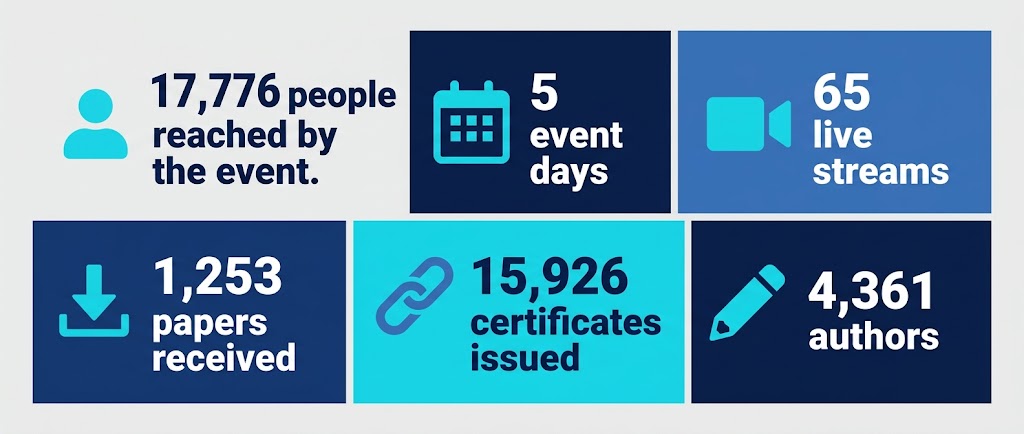
- 1,253 papers received and stored on Even3’s cloud — nothing had to be downloaded and forwarded by email.
- 95 reviewers automatically received papers and reviewed them right within the platform.
- 4,361 authors could check every stage of their paper’s review process directly on the platform.
- Presentations were automatically scheduled across the event’s 5 days.
- More than 15,000 certificates were sent out with a single click.
For Pricila Magalhães:
“The workload was just as heavy as the previous year’s, but the platform helped us enormously. Everything was so intuitive! And support was there for us from the very start.”
This made it possible to distribute responsibilities more effectively and pay closer attention to other areas of the event, such as accessibility.
In fact, all of this even led to changes in the platform itself.
“What we found really interesting is that some of our suggestions were actually implemented on the platform, and other people are already using them.” — Pricila Magalhães, organizing committee
What the Festival do Conhecimento teaches us about accessibility
For a large-scale event, making it accessible to everyone becomes an even bigger priority.
For Luiza Teles, of the organizing committee, accessibility solutions need to start as early as registration.
In this case, the registration form needs to be fully readable and fillable by screen readers, without any issues.
Another important strategy is asking, right in the registration form, which accessibility resource that participant needs — including listing the options as multiple choice.
In the case of the Festival do Conhecimento, the team had to be intentional about how they spent their budget, choosing to really get to know their audience in order to meet as many needs as possible.
In practice, the event held 22 live sessions focused on accessibility and used simultaneous captioning, Brazilian Sign Language (Libras) interpreters, and a Libras avatar — like the one available on the event’s Even3 website.
Looking ahead to future events
Ultimately, the two editions of the Festival do Conhecimento showed the power of bringing people together, drawing figures such as Ailton Krenak, Lázaro Ramos, Márcia Tiburi, and many other intellectuals.
And there’s still room to grow. Expectations for future editions are high.
“We’ve learned so much from all of this. We took a huge step that we only discovered we were capable of after we’d already taken it.” — Flávia Fortes, organizing committee
For the festival’s organizers, a third edition is already a given! But for an event built to be this different and ever-changing, there’s certainly still a lot to learn.
And that’s the best part of the Festival do Conhecimento: together, everyone learns something new — Even3 included.