If you were to attend the ideal event, what would it look like? Chances are, your preferences and goals make you part of someone’s target audience!
But do you know what your event’s target audience actually is? Defining it will help you create an event that’s more focused on the people who are already looking for you.
That way, it becomes easier to choose the program, sell tickets, and create marketing campaigns. Having a target audience shapes everything you do! It’s extremely important.
So here’s what you’ll learn:
- What is a target audience?
- Why define a target audience?
- Examples of target audiences for events
- How to define your event’s target audience
- What to do after defining your target audience
What is a target audience?
Basically, a target audience is a group of people who are more likely to be interested in what your event has to offer.
In other words, these are the people you want to reach, engage, and keep coming back.
Of course, they aren’t defined out of nowhere! The target audience is determined based on general characteristics, such as age, location, occupation, income, and interests.
In other words, when you answer the question “who is my target audience?”, you’re defining who your event should be aimed at.
This definition helps you organize more assertive events, with attractive programs, coherent communication, and successful promotion.
In short: the target audience defines who you want to reach, but with broad, strategic parameters. That’s what sets it apart from a persona.
What’s the difference between target audience and persona?
If you’ve already heard about the concept of a persona, you might be thinking the target audience is quite similar. But there are important differences between the two!
Both represent your attendees and guide decisions made about the event, but from different angles. They are:
- Target audience is a broader, more generic definition, based on demographic and professional data.
- Persona is a semi-fictional representation of an ideal attendee, built from real behaviors, pain points, goals, and challenges.
While the target audience answers “who am I selling to?”, the persona answers “how does this person think, decide, and behave?”.
In practice, the target audience guides strategy in a broader way, while the persona deepens communication and makes it increasingly personal.
For example:
- Target audience: corporate event organizers, between 30 and 50 years old
- Persona: Mariana, 38, marketing manager, who needs to prove event ROI and has little time to operate complex tools
Why define a target audience?
In short, defining your target audience is essential because it keeps your strategy from becoming too generic.
After all, when you try to speak to everyone, you end up connecting with no one.
By being clear about who your target audience is, you’re able to:
- Better communicate the value of your event and what makes it attractive
- Create a program that actually delivers what attendees are looking for
- Organize the event experience to meet attendees’ needs
- Create more relevant, personalized messaging
- Cut spending on ineffective marketing campaigns
- Increase conversion and engagement rates
- Make decisions based on strategy, not guesswork
- Choose the right channels to promote your event
What is your event’s target audience? See examples
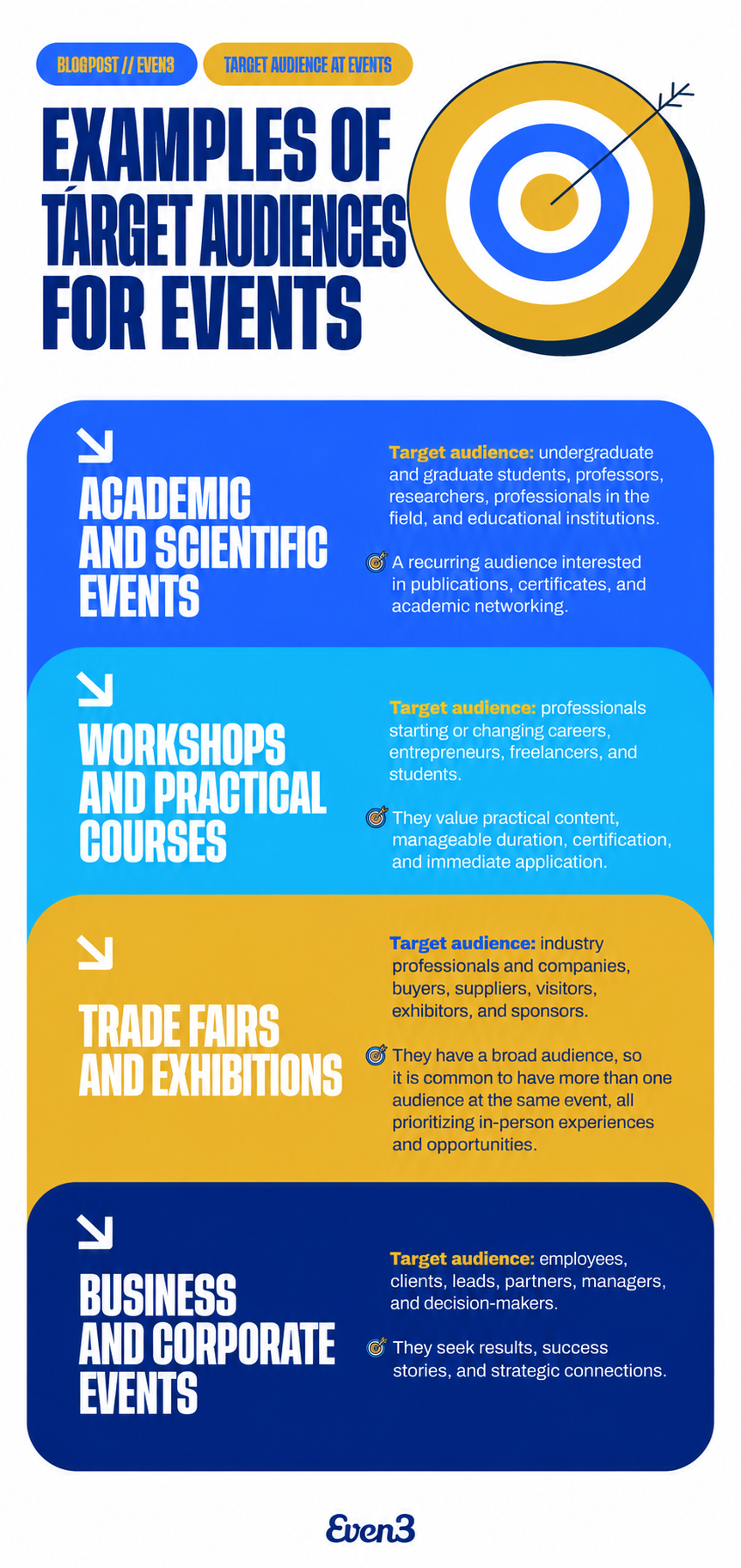
How to define your event’s target audience
1. Start with the event’s objective
The first step is understanding why this event exists. For example, do you want to train people, strengthen a community, or share knowledge?
Ask yourself: what transformation should the attendee experience by the end?
In short, the event’s objective works as a filter: it eliminates audiences that don’t connect with the proposal and helps answer who the most coherent target audience is.
2. Take a deep look at the event’s theme and format
The theme defines who’s interested. The format defines who’s able to attend.
Consider:
- The level of knowledge required (beginner, intermediate, or advanced)
- Whether the event is in-person, online, or hybrid
- Duration, hours, and dates
- Whether there will be a certificate, paper submissions, or structured networking
These factors help refine the profile and avoid generic communication.
3. Study the market and the competition
Have you stopped to think about how you’ll answer the questions above?
Studying the market is a good way to base your target audience definition on data.
So:
- Get to know the market your event fits into: what events already exist in the space?
- Who attends those events? What are they looking for?
- Analyze the competition, their audience, and their brands
- If you can, survey attendees from similar events or previous editions
4. Define demographic and professional segments
Here’s where you start structuring the target audience more objectively. List characteristics such as:
- Approximate age range
- Geographic location
- Field of work or education
- Job title, role, or experience level
- Type of organization the attendee belongs to
This data doesn’t need to be extremely precise, but it should be enough to form a well-structured profile.
4. Identify interests, pain points, and motivations
Even though it’s a broader definition than a persona, a target audience still needs to share a common problem or desire.
As you analyze it, try to answer these questions:
- What pain point does this event solve?
- What practical gain does the attendee expect?
- What would motivate this person to register today rather than later?
This information makes your target audience more realistic, with motivations and desires that can better guide your event’s communication.
5. Use data, history, and validation
Whenever possible, validate your assumptions with real data:
- History from previous events
- Registration and attendance data
- Attendee feedback
- Conversion rates from past campaigns
This helps you adjust your target audience based on evidence, not guesswork, making your strategy more data-driven.
What comes after defining your target audience?
Defining your target audience isn’t the finish line. Actually, it’s the starting point.
From that definition on, every decision about the event becomes more strategic and coherent.
Turn your target audience into a communication strategy
With your target audience defined, you’re able to:
- Choose the right channels (email, social media, partnerships, ads)
- Adjust tone, language, and sales arguments
- Create more relevant content for each stage of the journey
- Segment campaigns for different audiences, when necessary
This increases engagement rates and reduces wasted investment.
Structure registrations and offers aligned with your audience
Your target audience also influences:
- Pricing and creating ticket batches
- Specific discounts and coupons
- Group registrations or ticket categories
- Benefits and experiences offered
The more aligned your offer is, the greater your chance of conversion.
Use data to optimize results throughout the event
Once promotion begins, your target audience should be constantly analyzed:
- Which channels bring in the most qualified registrants?
- Which messages convert best?
- Where is drop-off or abandonment highest?
These answers allow for quick adjustments and improve your event’s performance in real time.
Put it all into practice with Even3
With Even3, you can apply all of this in a simple, integrated way.
After all, the platform lets you create your event, structure registrations, segment communications, and use marketing solutions designed to attract the right audience, at the right time.
With a custom event website, smart forms, coupons, a data dashboard, and email automation, you turn your target audience definition into real results.
Create your event on Even3 and put your strategy into action from the very first click.