
Did you know most event organizers make mistakes when signing a contract for their event?
That’s because many don’t know the rules that should be followed when hiring an events platform, vendors, speakers, and other suppliers…
For example, many people assume that anyone can sign a document. But an agreement is only fully binding when it’s signed by someone who is actually authorized to represent the event or organization.
On top of that, not every type of signature carries the same weight! Only some methods give you real legal protection and shield you from disputes down the road.
So, would you like to know everything that shouldn’t be missing from your event contracts? In this article, you’ll learn more about:
- Who can sign a contract for an event?
- Can I use a digital signature on event contracts?
- 4 tips for signing event contracts with more legal security
- The most common types of contracts in events
Who can sign a contract for an event?
First and foremost, the most important thing about an event contract is that it’s signed by the right person.
If you’re organizing as an individual, this is fairly simple: the contract should be signed by whoever created the event and is listed as the main organizer.
However, the situation is quite different if you’re representing an institution or a company!
If your event is tied to an organization, you need to be authorized by that organization to represent it in the contracts involved.
Otherwise, anyone could later claim you didn’t actually have the authority to represent the event or the institution, and try to undo the agreement.
Imagine the headache that could cause on event day! For example, a vendor could cancel a contract if it turns out you weren’t authorized to represent the company that hired them.
So always make sure a proper representative or legally authorized person is the one signing contracts for your event.
Difference between a legal representative and an authorized signatory
People who are typically authorized to sign contracts for an event include:
- Legal representatives: people who have the authority — set out in the company’s bylaws, articles of incorporation, or similar governing documents — to represent the organization in legal matters. Examples: directors and partners/owners.
-
- Authorized signatories: people authorized to represent the company in specific situations, usually through a power of attorney or a written delegation from a legal representative.
Examples: managers, or finance or marketing supervisors who hold written authorization to sign event contracts.
Can I use a digital signature on event contracts?
Now that you know who can sign a contract, it’s important to understand how that signature should actually be made.
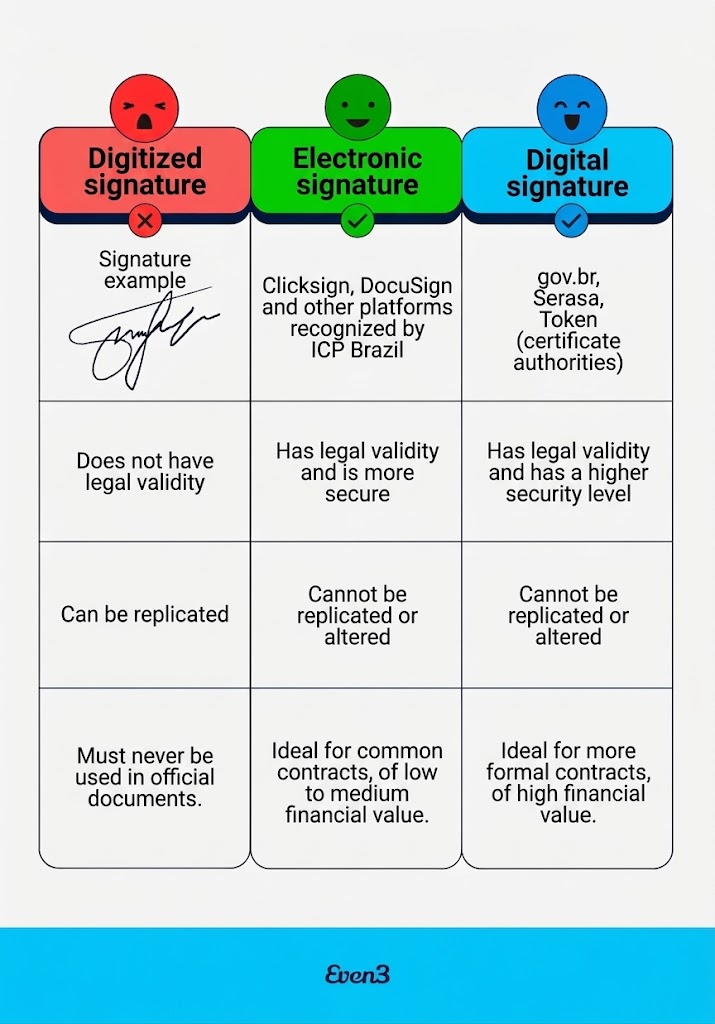
Yes, a digital signature can work, but avoid simply pasting a photo or scanned image of your handwritten signature into a document — that kind of “signature” can easily be challenged.
Ideally, use software that provides a secure electronic signature, built on encryption and identity-verification standards recognized in your country (for example, tools like DocuSign or similar e-signature platforms, or a provider that complies with your jurisdiction’s digital signature regulations).
These tools use technology that helps guarantee the document’s security and authenticity.
In fact, properly implemented digital signatures can be even more secure than a handwritten one!
4 tips for signing event contracts with more security
1. Research the company or vendor before you sign
Never close a deal without looking into who you’re actually hiring.
Even if you received a recommendation, check independent reviews, complaint boards, or business rating sites to assess the vendor’s reliability and the quality of their service. A trustworthy company will typically have a strong track record of resolving customer issues.
2. Never sign documents using a pasted-in image of your signature
As mentioned above, avoid signing documents with scanned images of a signature.
These can be challenged legally, since there’s no way to verify that the image was actually created by the person who “signed” it at the time of signing.
3. Be cautious with easily editable file formats
Be careful with contracts in open, easily editable formats like .doc or .docx.
PDFs are commonly used instead, but even PDFs can be edited without authorization if you’re not careful.
For that reason, prefer tamper-evident digital signature formats, such as those generated by dedicated e-signature tools, which lock the document and log any changes.
4. Consider signing as a legal entity (company), not an individual
If you run a company or are organizing an event on behalf of your institution, it’s often better to sign contracts as that legal entity rather than as an individual. This can offer several benefits.
For example, signing under a registered business is generally safer for everyone involved, since it’s easier to verify that the company is legitimate and actually operating.
On top of that, you may even get better rates on some services — Even3, for instance, offers plans with advanced features for organizations that run recurring events.
But remember: you still need to make sure the document is signed by someone who is a proper representative or authorized signatory of that company.
The most common types of contracts in events
In short, most of your event’s documents will need secure, legally valid signatures from someone who actually has the authority to sign — that is, the right representative or authorized person.
Here are a few examples of these documents:
- Service agreement: defines the services to be provided, such as decoration, catering, sound, and lighting. It spells out the scope of work, deadlines, and payment terms.
- Venue rental agreement: governs the rental of a venue for the event, including usage terms, hours, responsibilities, and associated costs.
- Sponsorship agreement: sets out the terms between the event organizer and a sponsor, detailing what the sponsor gets in exchange for financial or in-kind support.
- Image and likeness release form: authorizes capturing and using images and voice recordings of speakers and attendees. This document is essential to make sure photos and videos can be used in promotional or marketing material without infringing anyone’s image rights.
A quick, important note: contract requirements — what makes a signature valid, which clauses are mandatory, how a legal representative is defined, and so on — vary significantly from country to country. Nothing in this article is legal advice; before finalizing any contract, it’s always a good idea to have a local lawyer review it for your specific jurisdiction.
Make Your Events Run Smoother with Even3
Getting your contracts right is just one part of running a successful event. With a complete events platform like Even3, you can also:
- Create your event’s website;
- Sell tickets;
- Manage attendee and vendor data;
- Issue certificates;
- Send email and marketing campaigns, and much more.