
Does the term double-masked ring a bell from academic literature? If you already know a bit about paper review or methodology, you’ve probably thought of double-blind.
Basically, the concepts are the same, which is why you’ll see both terms used out there.
But why the change? Well, science has been evolving, and today there’s a greater focus on more inclusive and precise terminology.
The method we already know remains exactly the same! It’s crucial for ensuring the rigor and impartiality of scientific research.
So let’s understand what this means in practice. In this article, I’ll explain:
- What a double-masked study is;
- Use cases;
- How to implement double-masked paper review.
What is a double-masked study?
A double-masked study is a type of experiment in which neither the participants nor the researchers know who is receiving the main intervention and who is in the control group, avoiding factors that could influence the study’s behavior, analysis, or results.
This ensures greater objectivity and integrity in the data collected.
Double-blind vs. double-masked
You’ve probably noticed that double-masked is the same as the older term double-blind. However, the term has gone through a change!
Why?
The term “blind” carries an ableist connotation. It also doesn’t accurately reflect the methodological goal of the study, which is to conceal relevant information — not to deprive someone of sight.
That’s why “double-masked” has been adopted as a more appropriate, inclusive, and technically precise alternative.
It’s commonly used in international academic contexts, such as scientific publications and events. So you may also come across the English term: double-masked.
Use case: double-masked paper review
Beyond clinical studies, the double-masked concept can also be applied to the review of academic papers.
In this format, neither the author knows who is reviewing their paper, nor does the reviewer know who the author is.
This model reduces potential biases related to name, institution, gender, or nationality.
In practice, this approach is especially useful for ensuring that paper selection at events is based solely on the quality of the content, and not on factors external to the academic work.
It also avoids contact with reviewers, in case a student wants to clarify questions or dive deeper into the subject.
Benefits of double-masked review
Adopting the double-masked review model brings several advantages for organizing events and scientific journals:
- Greater impartiality in judging papers;
- Reduction of unconscious bias;
- Greater credibility for the selection process;
- Encourages participation from first-time authors or those from lesser-known institutions;
- Supports academic diversity and inclusion.
In addition, studies indicate that masked review processes can improve the quality of peer review, encouraging a more critical and neutral perspective from reviewers.
How do you run a paper review in practice?
To get started, you need to choose which type of paper review your event will use. This will depend on your goals and available resources.
What should you choose: simple review or double-masked?
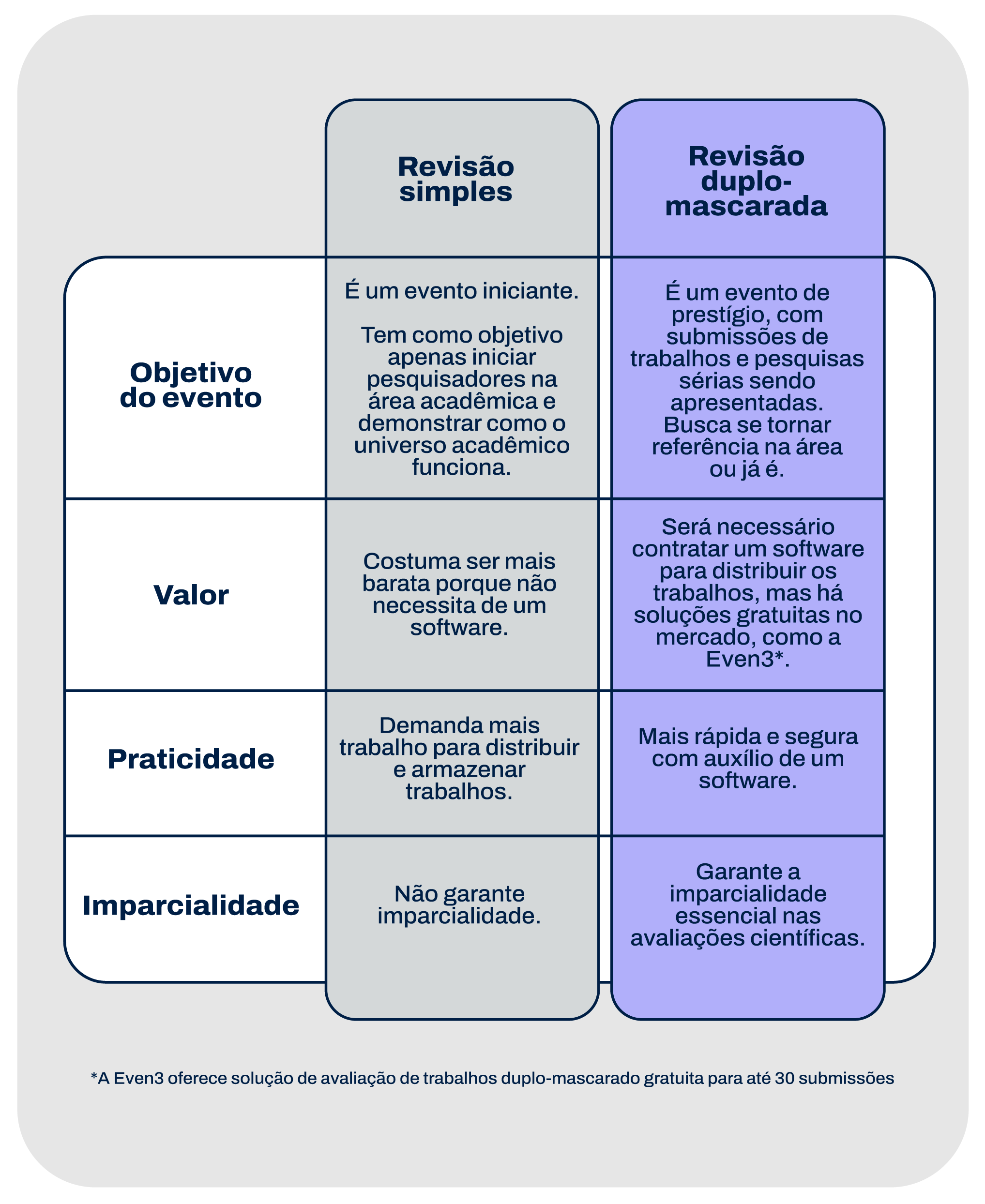
After that, it’s essential that the method you adopt is clearly specified in the submission guidelines.
These guidelines should be posted on the event’s website, and they need to be clear, accessible, and easy to reference. This way, you ensure transparency and alignment between authors and reviewers.
How do you conduct double-masked paper review?
If you choose double-masked review, it’s a good idea to use a paper submission platform to make distributing reviews easier.
So you should look for submission software with, at minimum, the following features:
✅ An event website with a paper submission area;
✅ Automatic distribution and sending of papers to reviewers;
✅ A paper review area for reviewers within the platform, avoiding email attachments and lost files.
How does double-masked review work on Even3?
Even3 is one of the platforms that offers these features — including for free, for up to 30 submissions.
In practice, it works like this:
- Set up the paper submission module and enable the standard review option. It’s already double-masked;
- Papers are automatically distributed anonymously to reviewers within the platform. They’re stored in the cloud, protected against copies and data loss;
- Corrections are made within the platform itself and returned to participants with anonymous comments, if applicable;
- Papers are classified as “approved,” “approved with revisions,” or “rejected.”
You can also customize review criteria, add submission rules on the event website, define a scientific committee, send communications to participants, and much more.