These days, applying digital marketing strategies for events is considered the key to boosting ticket sales.
After all, what’s the point of organizing and planning your event if the audience you want to reach doesn’t even know it exists?
No matter what type of event you or your institution organizes, your audience is very likely online.
According to PNAD research, the number of internet users in Brazil grew by 6.1 million between 2019 and 2024.
On top of that, compared to TV, billboards, or newspapers, social media can cost less to reach the right audience.
That’s why there are so many formats and channels you can explore to help your event grow and become known.
So, want to learn more about them? Read the article below and improve your marketing plan with the strategies that make the most sense for your event.
What Is Digital Marketing?
You’ve definitely visited a brand’s website and been hit with ads, or seen digital influencers promoting a product or service on social media, for example.
So you’ve already seen digital marketing in action!
Basically, digital marketing is a set of actions focused on promoting a brand, product, or service online.
In practice, this means putting your event in front of the right people, at the right time, with the right message, through the event website, email, ads, social media, and more.
Let me show you how this works in practice for events!
Why Use Digital Marketing for Events?
Did you know a study by The Boston Consulting Group found that 65% of internet users surveyed shop online?
And even when a purchase is made in person, 56% of users research online first.
In other words, people are more connected to the digital world than ever, and if you don’t keep up with this shift, you could lose ground to the competition.
That’s why digital marketing today is one of the most effective communication strategies for any type of business.
Its main benefits include:
- Greater event visibility: “If you’re not seen, you’re not remembered.” Online, your event is easy to access and crosses geographic borders, especially for online events;
- Attracting the right audience: Online, you can better target your content to reach specific audience profiles and impact people who are genuinely interested in your event’s topic;
- Lower cost per registrant: Online strategies to attract your audience tend to be more cost-effective and efficient than traditional methods, like print ads;
- More engagement: Emails, social media, and communities help keep your audience engaged;
- Real-time data measurement: Want to know if your event is working? With technology, you know exactly what’s working and can quickly adjust your strategy;
- More professionalism for your event: With a digital presence, your event gains more authority and trust in the eyes of your audience.
3 Key Concepts for Understanding Digital Marketing for Events
Before I show you what content you can create, I need to explain three basic concepts behind any digital marketing strategy for events: persona, lead, and sales funnel.
You’ve probably read a lot about these already! After all, without them, you risk promoting a lot… but converting very little.
1. Persona: Who Are You Talking To?
The persona is a semi-fictional representation of your event’s ideal attendee.
It works as a guiding character that helps you make decisions about how to promote your event, what to say, which channel to appear on, and even how to shape your program.
Unlike a target audience, which is broad and generic, a persona is specific and behavioral.
For example, an academic event might have young university students as its target audience. But the specific persona could be “Lucas, 22, engineering student, wants to attend fairs to land an internship.”
This lets you create increasingly personalized, direct content.
2. Lead: The Contact Who Shows Real Interest
In digital marketing for events, a lead is someone who’s raised their hand and said “I want to know more.” This happens when a person:
- subscribes to the event’s newsletter;
- downloads free material (e.g., preliminary program, e-book with speakers);
- fills out an interest form on the event website.
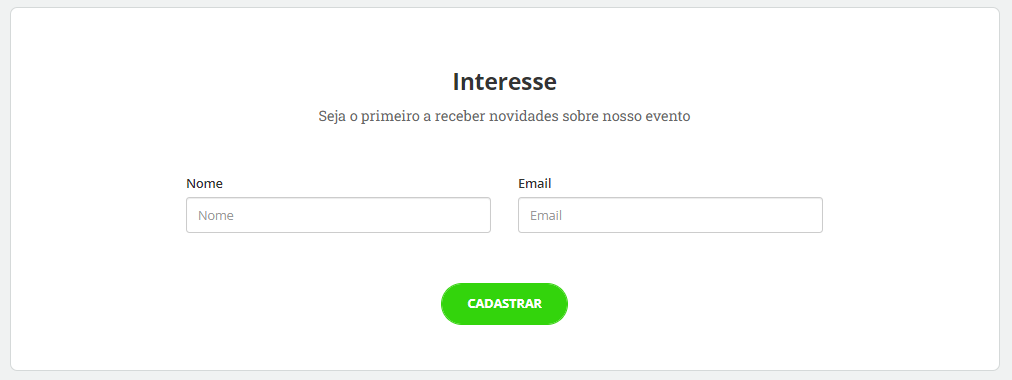
Then, using the data provided by the lead, you’ll start building a relationship with them to turn them into an event participant — walking them through the entire sales funnel.
3. Sales Funnel
In the context of events, the sales funnel is a model that represents the path your audience takes, from lead to event participant.
It’s divided into three stages:
- Top of funnel (discovery): At this stage, people are seeing your content for the first time. You need to attract them with educational, popular, interesting content — like social media posts with quick tips on your event’s topic;
- Middle of funnel (consideration): Those who’ve already shown interest start consuming more in-depth content and thinking of your event as a way to learn more or achieve specific goals — like e-books or livestreams related to the event’s theme;
- Bottom of funnel (decision): The person is ready to register and become a customer — like testimonial videos from past events, or invitations highlighting speakers or exclusive benefits of the current event.
In short, each stage should naturally guide the person toward registration, using strategic content.
In other words, don’t just think about selling! The secret is producing content that adds value.
But what kinds of content are we talking about? Let’s find out below!
8 Digital Marketing Strategies for Events
1. Content Marketing
To start, you need to understand the role of content within digital marketing. Basically, it’s the foundation of everything.
After all, it’s quality content that will mobilize your audience, help them, educate them, and bring them closer to your event.
So, content marketing is simply producing content aimed at attracting attention and naturally generating interest.
But it’s not just any content, okay? Besides adding value, this material needs to guide your audience through the sales funnel.
| Funnel Stage | Goal | Content Type | Event Examples |
|---|---|---|---|
| Top (Discovery) | Increase reach and attract interest | Educational posts, trivia, entertainment, shareable content | Content on industry trends |
| Middle (Consideration) | Nurture interest and generate leads | Rich materials, livestreams, testimonials, comparisons | Livestream with a guest speaker answering questions |
| Bottom (Decision) | Convert to registration or purchase | Direct offers, urgency, bonuses, personalized invitations | Short video with a speaker making a personal invitation |
2. Landing Pages
Since we’re talking about leads, I need to tell you about landing pages.
That’s because a landing page is simply a page created with a single goal: capturing leads.
Unlike your full event website, which has all the information about the program, speakers, and registration (like what you build on Even3), a landing page focuses exclusively on generating interest and collecting contacts.
How to use it for events
- Offer free content related to the event (e.g., e-books, webinars, or checklists);
- Add short forms asking for name and email to capture leads;
- Guide these leads through the sales funnel and turn them into loyal event participants.
Example: you organize an education congress and create a landing page offering an e-book on “10 innovative teaching techniques.” Anyone who downloads it leaves their contact info and starts receiving event updates.
Even3 tip: tools for building landing pages — Canva, Wix, MailChimp, RD Station.
3. Social Media
By now you’re probably wondering where to share your content, right?
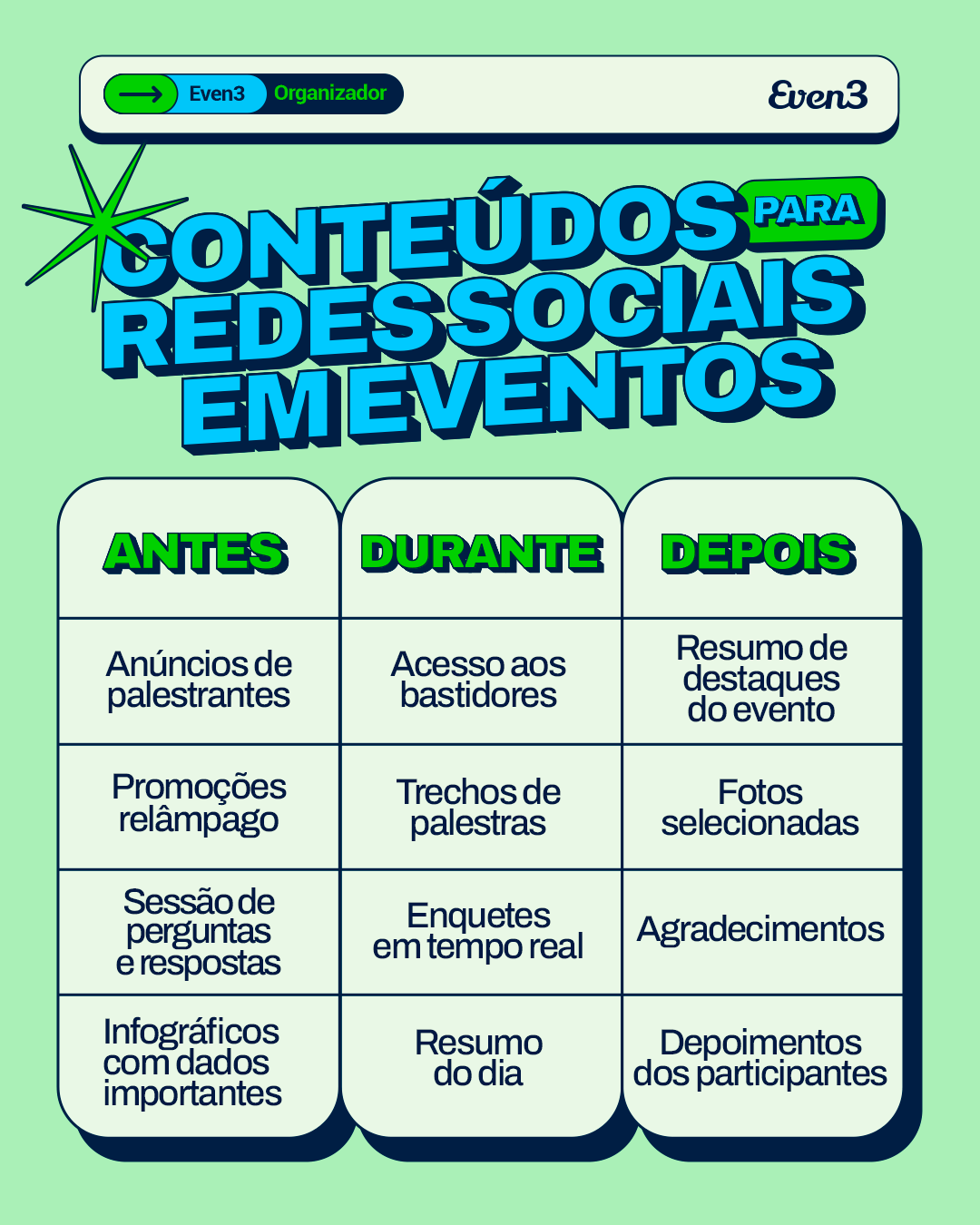
Social media is a great option! It can be explored in many ways, from content marketing to influencers, ads, and more.
In short, it’s essential for promotion and engagement.
But you don’t need to be on every platform! The secret is choosing the networks where your audience actually is and investing in them.
In general, audiences tend to break down like this:
- Instagram/TikTok: younger audience, visual content, videos, and interactivity;
- LinkedIn: corporate events, professional workshops, and congresses;
- Facebook: interest groups and local events;
- WhatsApp/Telegram: direct, personal communication, reaching audiences of various ages.
How to decide: know your event’s persona (age, interests, online behavior) and choose the networks where they’re present. Focus on content quality and posting consistency.
4. Sponsored Ads
Even though social media is free, you can invest a bit more to boost your posts.
And it’s definitely worth it! According to The Boston Consulting Group’s research, 56% of internet users are likely to click on an ad.
So if you want to go beyond organic reach, paid ads are the fastest, most effective way to reach the right audience.
For events, you can create different types of ads, such as:
📌 Social media (Instagram, Facebook, TikTok, LinkedIn)
Lets you target your audience by:
- Age
- Interests (e.g., “entrepreneurship,” “gospel music,” “street running”)
- Location
This way, you can create more strategic ads and reach people whose profile closely matches your persona.
📌 Google Ads
Here, you appear to people who are already searching for events like yours.
That’s why you’d create ads to appear among the top results on Google when people search for relevant keywords — for example, “2024 Education Symposium” or “street races in Recife.”
In other words, this audience has high intent!
5. Email Marketing
Nope! Email isn’t dead — quite the opposite!
According to Rock Content, back in 2018, 97.6% of internet users had an email address, and 95.9% checked their inbox daily.
On top of that, 76.8% of people had already made a purchase because of an email marketing message they received.
For events, email is where you’ll:
- Send reminders and information about the event;
- Nurture leads captured through landing pages or the event website;
- Stay in touch with potential participants, educating them and reminding them about the event’s benefits;
- Run post-event campaigns, like sending recorded content or information about upcoming events.
This lets you create segmented, personalized email marketing campaigns for specific groups within your audience.
Email marketing tools for events: Even3, Mailchimp, RD Station, Active Campaign.

6. Virtual Communities
As the name suggests, virtual communities are online spaces where your audience connects.
They tend to share content of interest and serve as a place to exchange experiences and discuss shared topics.
They’re powerful because they:
- Generate ongoing engagement, even before and after the event;
- Build authority for your brand or event;
- Make it easier to gather insights about your audience. It’s a great place to run audience research.
Where to create a virtual community
- Telegram, WhatsApp, Discord, Facebook Groups, LinkedIn Groups.
How to keep the community engaged
- Post exclusive content (tips, news, trivia);
- Run polls, challenges, or discussions;
- Respond and encourage active participation;
- Host introduction rounds, activities, and networking.
7. Influencer Marketing
Speaking of communities, many are built around an influencer as a reference point.
In fact, influencers have their own communities too, which you can tap into through influencer marketing.
Influencer marketing consists of partnering with people who have authority or a relevant audience in your event’s subject area.
How to apply it to events
- Invite influencers to be event ambassadors, offering free tickets or benefits.
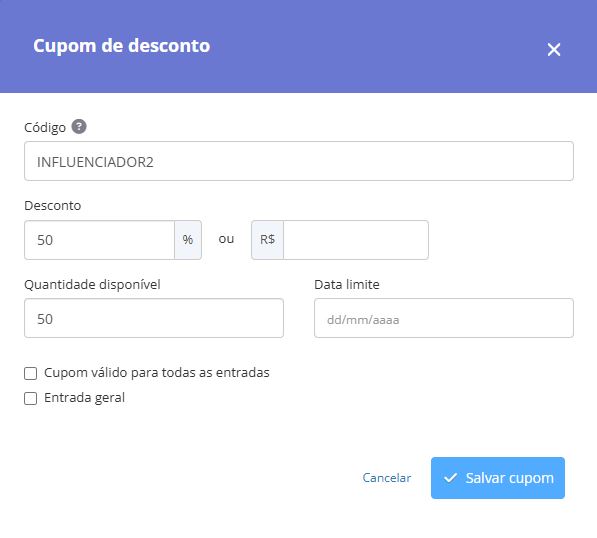
- Create exclusive registration links for each influencer and track results.
- Publish joint content, like livestreams, reels, or posts about their experience at the event.
With Even3, you can generate exclusive links or unique coupon codes per influencer, making it easier to measure registrations and engagement, and making the strategy more efficient.
8. Online Events
No, you didn’t misread that! You can also use events themselves as part of your digital marketing strategy, did you know that?
They’re not just products. They’re actually part of a broader digital marketing strategy.
Basically, they’re ideal tools for capturing leads and building anticipation for your event.
So, if you’re planning a large-scale event, it could be worth creating a few livestreams or webinars as a “warm-up” for the main event.
How to apply it to your event
- Create a website for these smaller events and capture lead data through the registration form;
- Keep consistency between the livestreams and the main event: use the same colors, connect the visual identity, and stick to the same branding;
- Promote related content on social media and through email marketing;
- Build online communities to strengthen your relationship with participants;
- Analyze results, like registration rate, engagement, and attendance, to adjust future strategies.
Finally, with Even3 you can centralize the entire process: build your event website, collect registrations, generate certificates, and integrate email marketing, ads, and content efforts.
This is your chance to turn every event into a complete digital marketing tool.
Want to see how it works? Create your event for free on Even3!