Check-in is the first in-person point of contact between you and your event’s attendees. When this moment flows well, the experience starts off light. When there are long lines, the picture changes: people arrive tired, lose time, and the overall perception of the event starts to be affected before they even get in.
In this clip from Even3 Tá On, Eduardo Marchetti of RX Brasil talks about how this is one of the biggest challenges event organizers face. The conversation showed how small structural decisions and the right use of technology help avoid bottlenecks and make access much faster.
In this article, you’ll understand:
- The impact of queues on the event experience
- How pre-registration reduces queues
- Structures and technologies that speed up access
- How evaluating the venue can prevent surprises
- A step-by-step to organize event flow
- How to measure satisfaction after check-in
How queues impact the event experience
The way an attendee arrives at the event directly influences their perception of the rest of the program.
When someone spends a long time stuck in a line to get in, park, or check in, enthusiasm drops and attention wanders. That draining start creates a negative impression in the very first minutes.
Long queues also create delays and impatience, which affects participation in the first activities and increases the sense of disorganization.
Even when the rest of the event is well structured, that initial discomfort weighs on the final evaluation, since attendees tend to associate a difficult arrival with the overall quality of the experience.
That’s why optimizing check-in and reducing queues isn’t just an operational matter. It’s a direct investment in the attendee journey and the event’s image.
When access is simple and smooth, the first impression is positive, and attendees arrive more ready to enjoy everything that was prepared.
How pre-registration reduces queues right at the entrance
One of the most effective ways to avoid queues is to encourage attendees to check in before they even arrive at the venue.
When this process happens online, the entry flow becomes lighter and the team can focus only on specific cases.
Pre-check-in reduces manual steps, avoids crowding, and reduces the need for large structures at the front desk.
“Ideally, attendees check in before arriving at the event. When everything is available online and registration is already done from home, access becomes much faster and queues practically don’t form.” — Eduardo Marchetti
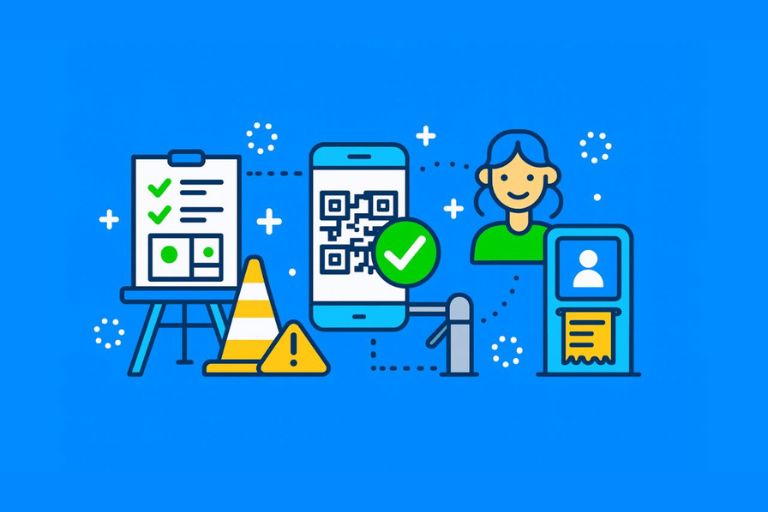
Arriving with their QR code in hand, attendees just need to bring their phone close to the reader to unlock access, which makes entry quick and organized.
For this to work well, communication is essential. It’s important to send clear reminders about how to complete pre-registration, reinforce how practical the process is, and guide attendees to keep their QR code somewhere easy to find on their phone. The simpler the journey, the higher the adoption.
Another good practice is to keep pre-registration open until the last moment. That way, anyone who forgot to register can complete everything on their own phone, avoiding long forms and manual data entry at the front desk.
This small change significantly reduces wait time and improves the experience for people arriving.
Getting ahead on check-in doesn’t require big investments — just organization and communication. When this step is well structured, queues shrink and the start of the event flows more naturally.
When to offer fast on-site printing
Even with pre-registration, there will always be attendees who arrive without their QR code in hand or who left registration for the last minute.
For these cases, keeping a fast printing point on-site avoids crowds and keeps the flow working.
The idea is to create a simple process: the attendee accesses the form on their phone, completes registration, and, with the generated code, heads to a printing station.
There, staff simply scan the code, print the badge, and grant entry within seconds. This model avoids long data entry at the front desk and drastically reduces wait time.
Organizing these stations well makes all the difference. Computers aligned with the flow, easily accessible printers, and a prepared team make service more direct.
“If an attendee doesn’t arrive with check-in already done, they can finish registration on their phone and only print the badge at a fast station. This avoids long forms at the front desk and keeps the entry flow working.” — Eduardo Marchetti
It’s necessary support for those who didn’t pre-register, without slowing down those who already arrive ready.
This structure doesn’t need to be large. With a well-designed flow and a guided team, the process stays agile, even at events with a high volume of attendees.
That way, you guarantee a smooth entry for everyone, including those who register at the last minute.
Structures and technologies that speed up access
The combination of good physical structure and the right technology transforms event check-in. When attendees can get in with just a few taps on their phone, the flow moves continuously and queues stop being a problem.
Platforms like Even3 help centralize this process, offering features that speed up access and reduce manual steps.
“When access doesn’t flow, attendees already arrive tired. Long queues take away enthusiasm and affect the perception of the event from the very first minutes.” — Eduardo Marchetti
1. QR code check-in
The QR code is one of the fastest ways to grant entry. Attendees just need to bring their phone close to the reader to validate access, with no data entry or slow lookups.
Even3 automatically generates a QR code for each attendee, enabling fast, secure check-in even during peak times.
2. Self-service kiosks
With kiosks, attendees scan their own code and print their badge without depending on staff.
This autonomy better distributes the flow and prevents everyone from concentrating at a single check-in point, making arrival faster and more organized.
3. Automated turnstiles with instant printing
For events with a large audience, automated turnstiles speed up the process even further. By showing the QR code, entry is granted and the badge is printed on the spot.
This system reduces time per attendee and keeps access flowing continuously.
4. Fast support stations for staff
Even with automation, it’s important to keep support stations to handle specific cases. Computers aligned with the flow and accessible printers help staff quickly assist anyone who needs guidance or arrived without their code.
These technologies don’t replace staff, but they help make operations more fluid. They take on repetitive tasks and give staff more time to guide attendees, answer questions, and ensure access stays organized from start to finish.
How evaluating the venue can prevent surprises
The event venue directly influences the entry flow, and that goes beyond check-in. Limited parking, congested access roads, few restaurants, or narrow circulation areas can create crowding at different points during the day.
That’s why mapping these points before the event helps you get ahead of solutions and organize a more balanced flow.
A good practice is to align expectations with the venue. Talking with the team responsible for the space, understanding peak times, and evaluating alternative routes lets you adjust important details, like extending opening hours or directing extra staff to critical points.
Small operational adjustments make a difference in the comfort of arriving attendees.
Another essential point is considering how many people the venue can absorb without causing bottlenecks.
For larger events, it’s worth planning external partnerships, offering alternative parking, or organizing waiting areas that keep the crowd moving.
The smoother the path to the entrance, the lighter the attendee’s first impression will be.
“Queues don’t only happen at check-in. They can appear in parking lots, on access roads, or at other points at the venue, and all of these factors influence the experience of people arriving.” — Eduardo Marchetti
A step-by-step to organize flow at large events
When an event welcomes a larger volume of attendees, every detail of access makes a difference. A small flow adjustment can prevent long queues and ensure a smoother arrival. This step-by-step helps you organize entry efficiently, even in the busiest scenarios.
Map audience volume and peak times
Start by estimating how many people will arrive at the same times, such as opening and the start of main activities. This helps you size the team, the number of check-in posts, and the size of waiting areas.
Split check-in into multiple points
Instead of concentrating everyone in a single line, create different check-in points. You can split by ticket type, attendee category, or pre-registered vs. on-site registration. This distributes the flow and reduces wait time.
Reinforce access with partners and alternative routes
For very large events, evaluate the venue’s surroundings. Consider partner parking lots, extra areas to receive vehicles, and alternative arrival routes. The more options you offer, the lower the risk of queues forming just to get into the space.
Adjust opening time and program start
If access tends to be slower, opening the gates a bit earlier and communicating this to attendees helps spread out the movement. It’s also worth planning the schedule so the first activity doesn’t start exactly at peak arrival time.
Simplify entry steps as much as possible
Whenever possible, eliminate manual processes. At large events, consider removing full check-in at the front desk and keeping only fast printing or self-service for those who already registered online. Fewer steps mean fewer queues.
Prepare staff to guide flow in real time
Train the team to quickly spot crowding points and redirect attendees to shorter lines or other access points. A well-positioned team with clear instructions makes a difference in keeping movement constant throughout arrival.
How to measure satisfaction after check-in
Understanding how attendees perceived their arrival at the event is essential to improving future editions.
Simple surveys sent right after check-in help identify points of discomfort, wait time, and the overall sense of organization. The closer to the actual moment, the more accurate the answers.
You can ask about the clarity of instructions, how easy it was to find the entrance, queue time, and quality of service.
With this information, you can compare perceptions between different groups, identify patterns, and understand which adjustments need to be prioritized.
This data guides practical decisions, such as reinforcing access points, adjusting opening times, testing new technologies, or redistributing staff.
Measuring satisfaction goes beyond collecting opinions: it’s about turning feedback into actions that make attendee arrival increasingly smooth.
When check-in works well, it sets a good first impression and helps attendees start the experience with more ease.
Reducing queues, organizing entry flow, and making access easier are simple measures that reflect on the comfort of arriving attendees and the overall perception of the event.
With planning, clear communication, and the support of the right tools, you can make this process more agile and direct.
Platforms like Even3 help centralize registrations, generate QR codes, and track check-in in real time, simplifying operations and reducing manual steps.