
Knowing how to organize scientific paper presentations is very important for the quality of an event. However, planning the scientific program takes a lot of work and attention.
One of the biggest challenges in organizing paper presentations is defining and allocating papers according to participant availability, the number of papers, and room capacity.
You also need to pay attention to the format of each presentation. Some may be oral, which means you need to set a time limit for each presentation, while others may be poster sessions, which require planning room capacity.
For events with few presentations, managing the scientific program can be done with spreadsheets, where you can organize the whole schedule.
But for large events, organizing presentations manually can turn into chaos. It’s hard to keep track of participant availability, which can cause scheduling conflicts and hurt the event’s overall organization — leaving a bad impression on participants and making it harder to manage presentations.
Challenges of Organizing Paper Presentations at an Event
As an organizer, you probably find it challenging to manage the volume of papers within the deadline while accommodating each reviewer’s preferences. Sound familiar?
You also need to think from the participants’ perspective, since they’re the ones who’ll present at the times you set!
For everything to run smoothly and spark good discussion, organizers should group paper topics into common areas. If that doesn’t happen, it can get confusing for everyone!
Another big challenge is getting reviewers engaged, since they generally aren’t very comfortable with digital tools and don’t always keep the system updated with paper evaluations within the set deadlines.
On top of that, building spreadsheets — even when you already have all the information in hand — is exhausting. So you’re probably wondering what’s the best way to organize paper presentations at your event. Don’t worry, we’ll tell you!
Tips for Organizing Presentations
First, before opening the call for papers, make sure you already have all the rules, deadlines, and reviewers defined.
You also need a plan for every stage and should rely on supporting tools.
Using technology to your advantage makes organizing presentations much more practical! This will streamline your work and the rest of the organizing committee’s. Choosing a system that automates tasks that would otherwise require a manual process — taking up organizers’ time and effort — is a great option!
If you already use management software, make sure the platform is already set up and running, with participants registered and the paper submission period open.
And be careful! You should use only the system, since splitting management between the system and another tool (a spreadsheet, for example) makes the organizational work far too complex to control.
What’s the Best Way to Organize Paper Presentations?
Being able to organize and access information quickly and practically is every organizer’s goal, right?
That’s why it’s always better when the system gives you access to a ready-made schedule, which is also useful for documenting the event’s projects.
It’s recommended that these events use management software to eliminate bottlenecks, gain productivity, and deliver a great experience to participants.
Do you know the biggest advantage of using a paper submission system? It’s the reliability of managing the evaluation process, along with its connection to registrations, which makes it easier to keep track and avoid payment issues.
With that in mind, Even3 provides a tool that automates the entire process of organizing the scientific program.
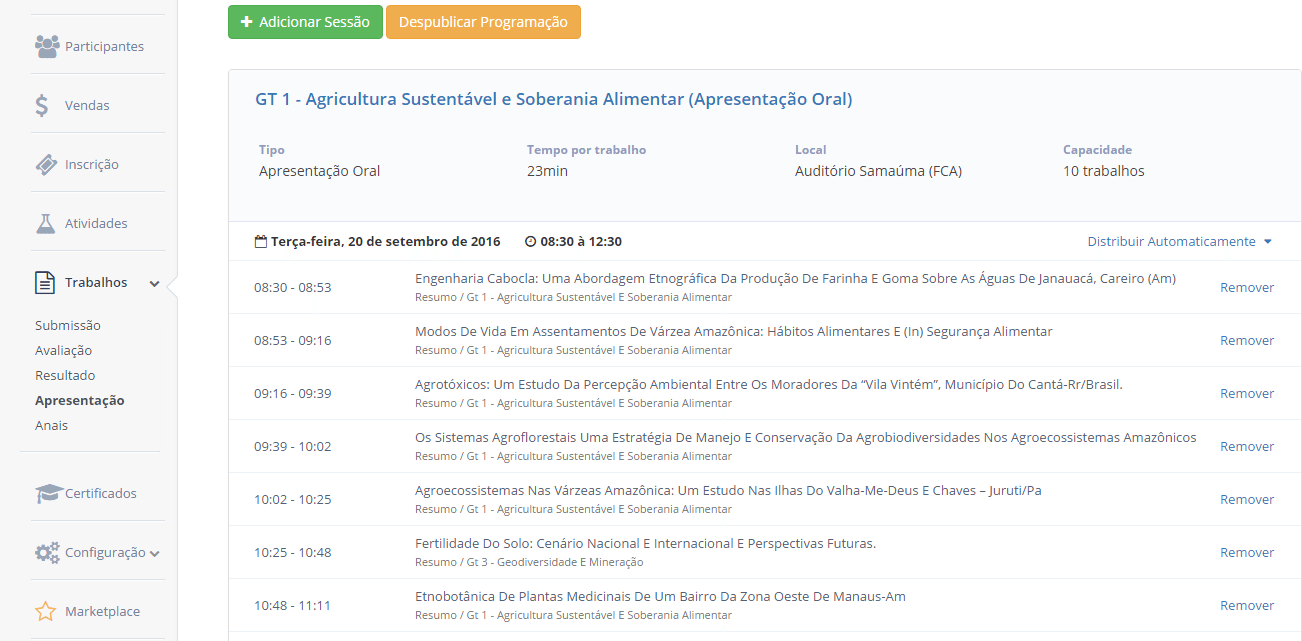
With this tool, you can build the complete presentation schedule in just a few clicks. It helps avoid scheduling conflicts, estimate the number of papers, and easily allocate time slots based on room and participant availability.
It also gives you the flexibility to make any kind of change at any time.
You can register multiple sessions and define the presentation format, duration, locations, and dates.
To make the distribution process easier and faster, papers can be automatically allocated according to their category and thematic area.
There are 2 types of presentations — here’s how you can organize each one!
Organizing Oral Presentations
For oral presentations, you need to choose the presentation time each author will get. You’ll also determine when the presentations will take place.
Remember to define the time window for presentations — whether it’s in the morning from 8am to 12pm or in the afternoon from 2pm to 6pm, for example.
If your event has 2 days of presentations, for example, you can set that duration and choose the dates papers will be presented. Don’t forget to also let people know the presentation location.
Organizing Poster Presentations
Poster presentations differ from oral ones in one key aspect.
First, you need to be careful when choosing the location. Instead of setting how much time each participant gets to present, you’ll determine the number of posters/banners that space can hold.
How Does It Become Available to Reviewers and Participants?
In the end, you can publish the schedule for participants and reviewers, letting them search by name, location, day, or time — and also see who’s presenting each paper.
Organizing scientific paper presentations can be very simple and doesn’t need to be done with complex spreadsheets. Value your time and your event’s quality — schedule a demo of this feature now and add it to your event.