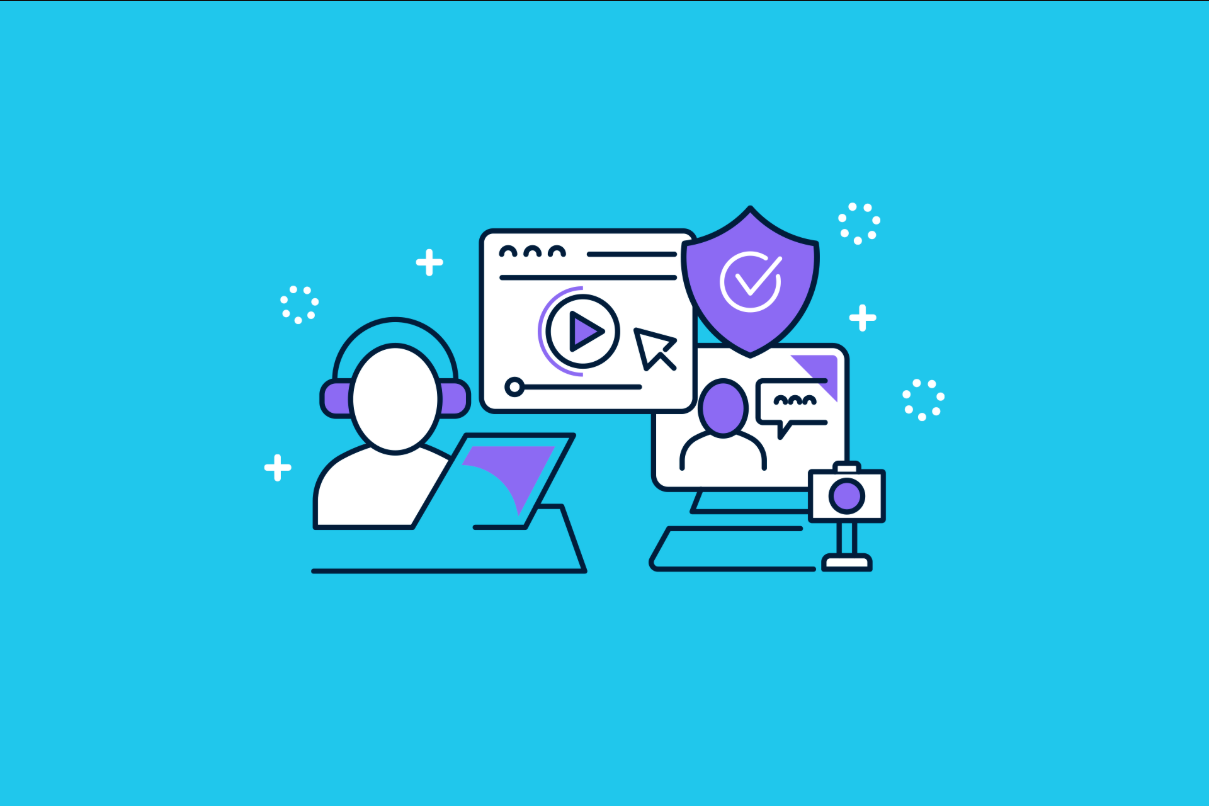
Creating an online broadcast increases your event’s potential reach, letting you connect with people from all over the world.
The most popular broadcast format is live streaming, but it can also be a video conference or even something recorded in advance.
On top of that, you can use free or paid tools to run your online broadcast. It all depends on your goal.
That’s why I’ll walk you through everything you need to know about the topic: how to put on a good broadcast and which tools to use.
Types of Online Broadcasts and the Main Tools
Before creating your online broadcast, you need to know the main formats and the tools available on the market. Here they are:
Video Conference
A video conference is a type of online broadcast that works as a closed meeting.
It happens in a virtual room that’s only accessible with a specific link or invitation.
For that reason, it’s commonly used to broadcast paid content that requires registration.
It also allows for live conversation with active audience participation, since some tools let listeners interact through audio and video.
On top of that, they can include more advanced technology, such as polls, screen and slide sharing, live simultaneous translation, and much more.
But for those who opt for more basic use of these tools, organizing the event tends to be quite simple and quick. Just invite people to join you in the room!
Advantages of Video Conferencing
- Easy to organize for people just getting started with online events;
- Manual control over who enters the room, which is ideal for small events;
- There are several free, easy-to-use tools on the market.
Disadvantages of Video Conferencing
- Everyone needs to join the room to take part in the event;
- Attendees don’t always know how to use the tools. Sometimes you need to manage open microphones and cameras to avoid awkward moments.
Who Is It Best For?
Video conferencing is highly recommended for beginners, small events, and anyone who needs a closed environment with control over attendees.
It’s commonly used for live courses, since it creates a very interactive environment for them.
Video Conferencing Tools
Google Meet
Google Meet is one of the most popular video conferencing platforms because it’s integrated with Google’s services.
Because of that, many people already have access to the tool and know how to use the free version.
But like most video conferencing tools, Google Meet has limitations on its free plan.
In that version, you can only host meetings with up to 100 people for 60 minutes.
Another downside is that access control is difficult on any plan.
If attendees’ emails aren’t registered in advance, you’ll need to approve their entry during the video conference.
Despite that difficulty, the paid version offers unlimited meetings and can include interesting benefits, such as automatic captions and meeting recording.
The business plan also lets anyone who’s part of your organization join calls without needing approval.
This makes Google Meet a great solution for internal training as well.
Zoom
Zoom is a very popular video conferencing software. It has a fairly intuitive, customizable interface with robust features.
Like Meet, it has a free plan with limitations, such as meetings with up to 100 people for only 40 minutes.
But the paid version of the app includes screen sharing, meeting recording, and breakout rooms.
On top of that, it has advanced features like simultaneous translation and the webinar option, which allows for real-time interaction and Q&A sessions.
Skype
Skype is known for being accessible and easy to use, making it a popular choice for both personal and professional use.
It offers free video and voice calls, instant messaging, and the ability to share files.
Skype’s free plan allows video calls with up to 50 participants.
For additional features, such as international calls at reduced rates, Skype offers paid credits and monthly subscriptions.
Live Online Broadcasting
In practice, most online event broadcasts happen live. This is the format we call live streaming, or simply a live.
In this format, recording and broadcasting happen at the same time, and it’s common for events like webinars and talks.
Advantages of Live Broadcasting
- Easy to broadcast. In theory, it can be done from anywhere;
- Few tools are needed for the recording — you’ll just need a laptop or smartphone, a good internet connection, and a microphone;
- Wide reach: the live-chat format tends to attract people interested in real-time connections, especially if your event is free and open to the public;
- There are good free tools for running the broadcast.
Disadvantages of Live Broadcasting
- Issues like an unstable internet connection can happen, which can prevent the event from happening;
- Broadcasting over Wi-Fi runs a high risk of lagging or freezing. Using a wired connection is recommended;
- Some tools limit access to the broadcast to registered attendees only, like Instagram.
Who Is It Best For?
Live broadcasting is typically recommended for one-off, shorter activities, from 1 to 2 hours long.
That’s because the content is meant to be absorbed in the moment and to spark interest in learning more.
However, since it’s a very interactive format, some larger events also include lives in their schedule.
After all, they offer a unique opportunity for live Q&A, like webinars, which combine explaining content with constant interaction with attendees through chat.
Live Broadcasting Tools
YouTube Live
YouTube Live is one of the most popular live broadcasting platforms. In fact, many people go there specifically looking for this kind of event.
That’s why it’s an excellent choice for public events, allowing for wide interaction and viewership.
It’s free for all users, but it requires the live feature to be enabled with a 24-hour notice.
On top of that, the live isn’t recorded directly on the platform. YouTube needs the video to be recorded in another tool and streamed to it, as if it were a recording studio.
Advantages of YouTube Live
- It’s the most popular live streaming tool, it’s accessible, and it has great reach;
- You can schedule lives and create a reminder for them;
- It’s free;
- Option to interact with attendees via chat;
- You can broadcast publicly or as unlisted (only for users with the link);
- You don’t need a YouTube account to watch the broadcast;
- Your channel subscribers will be notified by email about new broadcasts.
Disadvantages of YouTube Live
- The live can’t be recorded directly on the platform. You need software that records the broadcast and mirrors it to YouTube, like Streamyard;
- It’s hard to control who watches the broadcast, since any user with the link can access it;
- Once you enable the live feature on your YouTube account, you need to wait 24 hours before running your first broadcast.
Streamyard
As mentioned, YouTube needs software to record the broadcast, acting as a virtual studio.
Streamyard is one of the most well-known options.
It lets you add professional elements to broadcasts, such as images, multi-camera interviews, and screen sharing.
But the tool’s free plan is fairly limited. This leads many people to turn to other similar free alternatives, like OBS Studio.
Advantages of Streamyard
- One of the easiest online streaming tools to use on the market;
- Offers several layout customization options, such as frames, video insertion, logo, and more;
- You can insert CTAs during the live and display chat comments on the broadcast screen;
- Stores recorded content while preserving audio and image quality;
- Access to data on watch time, interaction rate, and audience retention;
- Simultaneous broadcasting on different platforms, such as YouTube and Even3.
Disadvantages
- The free plan only offers 20 hours of online broadcasting on a single channel;
- There are free tools available on the market that do the same thing, like OBS Studio.
However, if you’re looking for a tool that runs online broadcasts natively, then you need to know about Instagram Live.
Instagram live broadcasts are easy to start and can be seen by all your followers. The platform even sends them notifications.
The feature is free, but live broadcasts are limited to 60 minutes and can only be watched by people who also have Instagram.
This makes Instagram Live ideal for informal events and previews of bigger events. But it can also be useful for Q&A sessions and direct interactions with your audience.
Advantages of Instagram
- Very easy to broadcast;
- Doesn’t require expensive equipment;
- Free;
- High reach;
- You can enable or disable comments during the broadcast;
- No limit on the number of viewers.
Disadvantages
- You need an Instagram account to watch the broadcast;
- Competes for viewer attention with notifications, other live broadcasts on the platform, and other apps;
- Lives tend to function like chats and don’t have an elaborate layout;
- Instagram’s live broadcast time limit is 60 minutes.
Twitch
Twitch is a hugely popular online broadcasting platform, especially among younger audiences.
After all, it’s commonly used to stream games, sports, and lives with influencers.
But its flexibility and features also make it an excellent choice for other types of events and live broadcasts.
In fact, it can be a great strategy for events aiming to reach a younger audience, such as events from educational institutions.
Like YouTube, Twitch also requires online streaming software.
That’s why the platform developed its own and offers it for free.
Advantages of Twitch
- Offers content monetization options, such as paid subscriptions, donations, and ad revenue;
- Can be accessed by anyone, even without an account on the platform;
- The platform has an active, dedicated community that’s often highly interactive and loyal to the creators they follow;
- Free tool.
Disadvantages
- Requires external software to broadcast the live, like Twitch Studio;
- Many monetization limitations for beginners in online broadcasting;
- People without an account on the platform can watch content, but can’t take part in the live chat.
Recorded Broadcasts
Basically, a recorded broadcast is video that’s recorded in advance and made available to the audience at a specific time.
In some cases, it can simulate a live broadcast, being released at a specific time with no access afterward. This format is known as a simulive.
In others, the video is released and can be accessed by attendees at any time.
This format can be ideal for anyone who wants to create more polished videos.
After all, it allows for editing and protects against common live-broadcast issues, such as microphone failures and internet outages.
Advantages of Recorded Broadcasts
- It’s the safest broadcast format against unexpected mishaps;
- Possibility of creating more polished, professional-looking content;
- Has more varied, creative editing options;
- Attendees can watch the content whenever and as many times as they want;
- Expands possibilities for sponsors, since it allows for brand placement, bumpers, and commercials.
Disadvantages of Recorded Broadcasts
- Without an events platform, the speaker can’t interact with attendees during the broadcast in real time;
- Speakers may struggle to record materials if they aren’t well guided.
Who Is It Best For?
Recorded broadcasts are recommended for events with more complex content that needs time to be produced and also absorbed by attendees.
Because the content can be rewatched, this format has been offered at large events that combine different types of activities happening at the same time.
They’re also quite common at international events, since they offer a viable solution for dealing with time zone differences.
A Tool for a Safer Online Broadcast
Some tools can work for any type of online broadcast, whether video conferences, lives, or recordings.
That’s the case with Even3 Streaming.
It’s an online broadcasting tool developed by Even3 where videos are stored directly on the platform.
This ensures the broadcast is protected and also offers different kinds of benefits for each event format.
For example:
- Recorded content available to attendees for 30 days or more;
- Interactive tools available during the broadcast, such as chat, polls, giveaways, and more;
- Single-access-link technology: the link can’t be shared with people who aren’t registered;
- Protection of content against intruders;
- Broadcast that’s secure against takedowns: content can’t be pulled offline, since it’s hosted on Even3.
How to Create a Good Online Broadcast?
By now, you already know the tools available for creating online broadcasts.
But regardless of which tool you use, it’s important to focus on content quality and engagement.
To help with that, here are some tips:
Planning
- Make sure to plan every detail of your broadcast in advance, including the content, the schedule, and the main goals;
- Run full tests before the event, checking all equipment and the broadcasting platform you’ll use;
- Also check the video and audio to make sure everything is clear and high quality;
- Prepare a detailed event script to stay organized and make sure every topic is covered.
Broadcasting
- Use natural light whenever possible. If natural light isn’t available, invest in equipment like softboxes or light reflectors to ensure even, professional lighting;
- Use external microphones or headsets with a built-in microphone to improve audio capture and minimize background noise;
- Check the stability of your internet connection and consider using a wired connection instead of Wi-Fi for greater reliability;
- Use interactive features like live chats, polls, and Q&A sessions to keep the audience interested and engaged;
- Have a technical support team on hand to fix any issues that come up during the broadcast;
- Use a professional backdrop to improve the broadcast’s visual appearance.
Speaker
- Inviting speakers from different regions or even from abroad can enrich your event. Make sure to align time zones correctly;
- Make sure your attendees know how to use the chosen platform. If possible, run a training session or a test before the event day.
Content
- Make sure the recording environment is quiet and free of distractions to maintain audio and video quality.
- Consider recording the broadcast to make it available later for anyone who couldn’t watch live.
- Make your content available on a broadcasting platform that fits your needs and is accessible to your target audience.
By following these tips, you’ll be ready to run a successful online broadcast, giving your audience a professional and engaging experience.
Now it’s time to choose the ideal online broadcast format and start building your event.
Discover how Even3 can help you put on the event of your dreams.