Did you know that most events don’t have a quality problem, but a strategy problem?
Maybe your content is great, but the people who visit your event website don’t register. You invest in promotion, but sign-ups don’t grow; sales only pick up in the last week, under pressure…
If any of these scenarios sound familiar, the problem probably isn’t your event. It’s the lack of a sales funnel.
It turns strangers into participants in a surprisingly simple way. Just follow the steps. Read on to learn more about:
- What is a sales funnel?
- What are the stages of the sales funnel?
- When should you build a sales funnel for events?
- How to build a sales funnel for events?
- 3 essential tools for an event sales funnel
What is a sales funnel?
If you’ve ever tried to sell tickets for an event and felt like you were “shouting into the void,” what’s probably missing is a well-structured sales funnel.
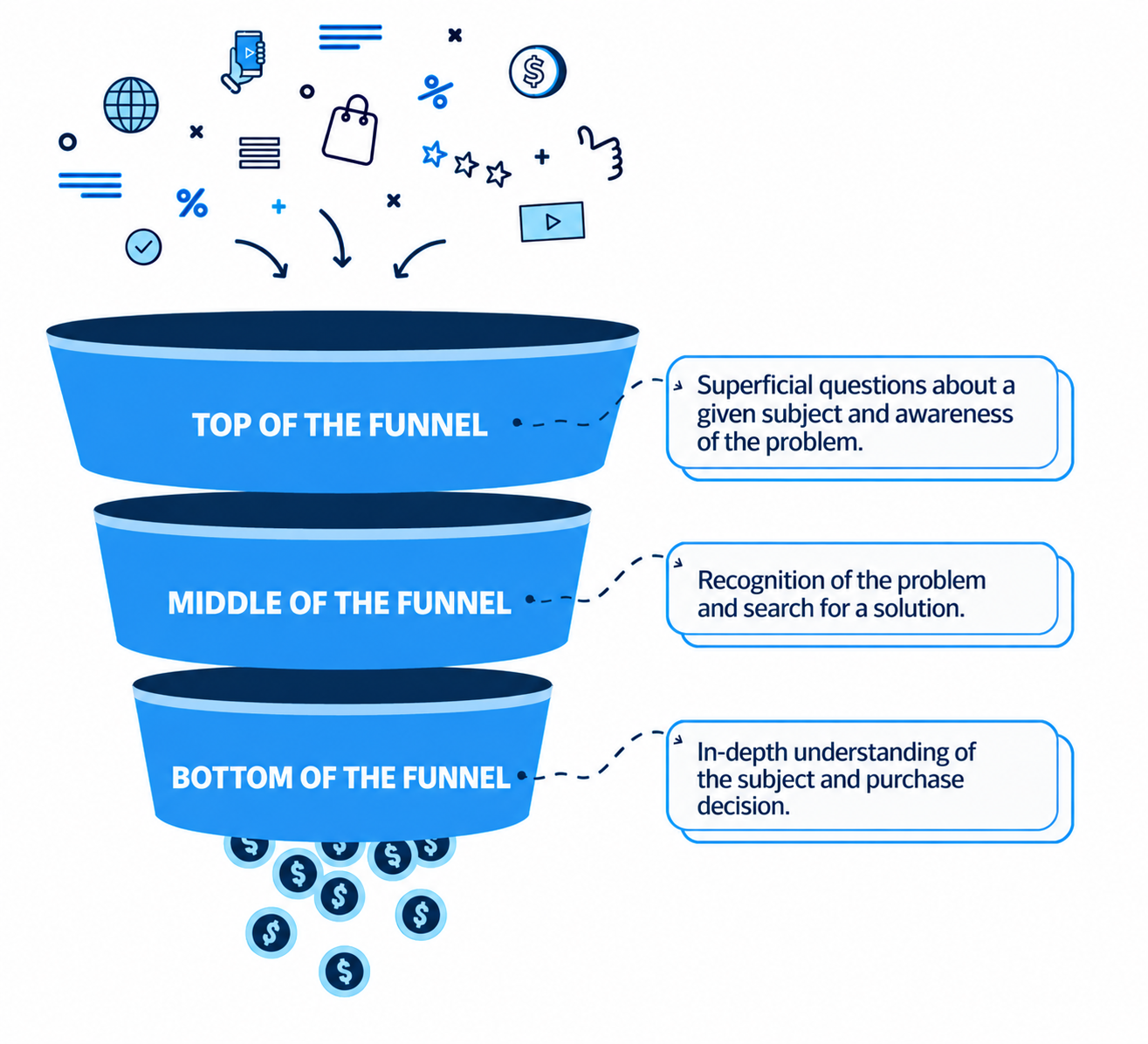
Basically, the sales funnel is the visual representation of the journey a person takes from their first contact with your event to the decision to buy a ticket (or register).
The name “funnel” isn’t random, either: just like a physical funnel, it starts wide.
That is, many people are discovering your event, but the journey narrows through different stages until it reaches the participants who actually convert.
This structure exists because people rarely buy the first time they hear about something. They discover, research, compare, build trust, and only then decide.
So, the sales funnel is the strategy that intentionally guides that path.
What are the stages of the sales funnel?
As mentioned, the sales funnel has stages. Broadly, it’s divided into: top, middle, and bottom. Here’s what each one means!
1. Top of the funnel (ToFu): Discovery and awareness
Here are people who don’t know your event yet, or don’t know they need it.
Often, they have a problem your event could solve. For example, they might be students looking for more knowledge who don’t yet know they can get it at your event.
Once they discover it and engage with it, these people become leads.
Goal: catch attention and generate interest.
Content examples:
- Educational posts (e.g., “everything you need to know about [event topic]”)
- Short videos on social media
- Blog articles
2. Middle of the funnel (MoFu): Recognition and consideration
At this stage, it’s time to nurture the lead. They already know they have a problem or interest and are evaluating options.
So your lead might be comparing your event to others, weighing dates, prices, and the schedule.
Goal: educate and show value.
Content examples:
- E-books about the event’s topic
- Webinars or livestreams with speakers
- Emails with the full list of confirmed speakers, sent to people who have already visited the event website
3. Bottom of the funnel (BoFu): Decision and purchase
Here’s the “hottest” lead: they know your event, they’re interested, and just need a little push to convert.
So social proof, urgency (“last tickets left!”), and special offers work very well here.
Content examples:
- An event website with clear benefits
- Testimonials from past editions
- Alerts on the event website
- Time-limited offers (promotional pricing tiers)
When should you build a sales funnel for events?
Ideally, you build your funnel before registration even opens.
In practice, this means the funnel starts alongside event planning.
Ideal moments:
- When defining the event’s theme and audience
- Before starting promotion
- When you want more predictable registration numbers
Why?
Without a funnel:
- ❌ You promote without a strategy
- ❌ You rely on engagement spikes
- ❌ You struggle to predict results
With a funnel:
- ✅ You build interest over time
- ✅ You educate the audience before selling
- ✅ You increase your conversion chances
How to build a sales funnel for events?
Now that you understand what a sales funnel is and its stages, let’s get to what matters most: how to build a sales funnel in practice for events.
Step 1: Clearly define your target audience
Before any action, answer this: who is your event’s ideal participant? What’s their profession, desire, pain point, experience level? The more specific you are, the more effective every stage of the funnel will be.
For example, an academic event might target students who need to publish papers or network.
Step 2: Create content for each stage of the funnel
Here’s the heart of the strategy, since each stage requires a different type of content and approach:
Top of the funnel: Educational and discovery content:
- SEO-optimized blog posts on topics related to the event’s world
- Reels and short videos about trends in the field
- Podcasts or guest appearances on industry podcasts
- Infographics and informative social media posts
- Awareness ads with broad reach
👉 Goal: attract people who don’t yet know about the event
Middle of the funnel: Consideration and deeper-dive content:
- Event landing page with the schedule, speakers, and benefits
- Segmented email marketing for people who visited the page but didn’t buy
- Free webinars or livestreams with confirmed speakers
- Case studies or testimonials from past editions
- FAQ answering the main questions about the event
👉 Goal: deepen interest
Bottom of the funnel: Conversion content:
- Emails with urgency triggers (last pricing tiers, deadline closing)
- Testimonials and social proof featured on the event website
- Retargeting ads for people who visited the page but didn’t buy
- Special offers (group discounts, early bird)
- Abandoned cart recovery email sequences
Step 3: Capture leads
As mentioned, anyone interested in your content becomes a lead. But it’s pointless to create top-of-funnel content if you have no way to capture the contact of the people who showed interest.
After all, how will you reach that person? How will you send targeted content and convince them to buy a ticket to your event?
That’s why the most important step in the funnel is turning anonymous visitors into identified leads. That is, people with a name, an email, and ideally some information about their interest.
Ways to capture leads for events:
- An event app;
- A landing page with a “notify me when registration opens” form;
- A form to download a free resource related to the event’s theme;
- Waitlist sign-up.
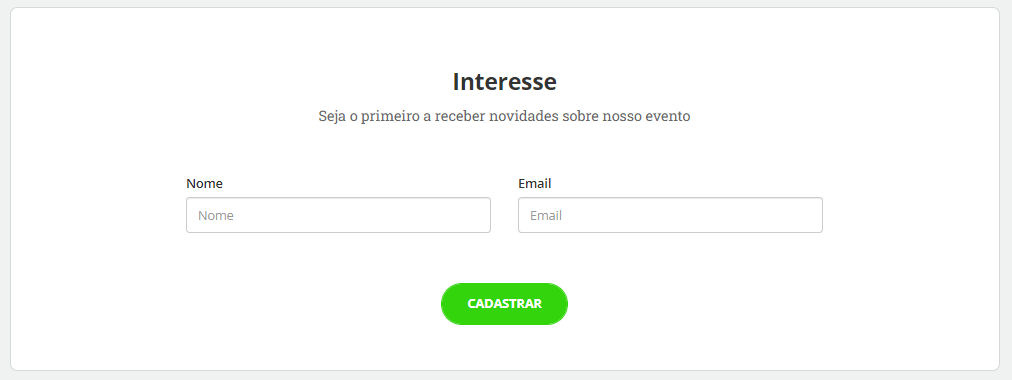
Interest area for lead capture on an event website in Even3
Step 4: Nurture the leads
Have information about the lead? As mentioned, now it’s time to build a relationship!
In other words, it’s time to send content created specifically for the lead, based on what you already know about them.
According to HubSpot, companies that nurture their leads with segmented content generate 50% more sales at a 33% lower cost than those that don’t.
In practice, this can be done through:
- Email marketing
- Segmented content
- Targeted ads
Step 5: Analyze and continuously optimize
After all, a funnel is never “finished.”
So track the metrics at each stage (email open rate, click rate, landing page visits, conversions) and identify where leads are “leaking.”
For example, if many people visit the sales page but don’t buy, the issue might be the price, the copy, or a lack of social proof. If few people reach your site, the problem is at the top of the funnel.
In short, you need to keep observing and testing to continuously improve your event’s sales funnel.
3 essential tools for an event sales funnel
Finally, for your sales funnel to truly work, you need tools that support every stage of the journey. Here they are:
1. Lead collector (landing page or app)
This is the foundation of your funnel.
A lead collector lets you turn visitors into contacts — people you can nurture over time.
Without a collector, you lose segmentation and conversion opportunities throughout the funnel.
What it does in practice:
- Captures the audience’s name, email, and other information
- Offers something in return (e.g., registration, content, waitlist)
- Organizes leads for future actions
Examples:
- Landing page with a free resource download about the event’s topic;
- Event app that allows direct communication with participants.
#Even3Tip: Some tools, like HubSpot and RD Station, have a simple, easy-to-use landing page builder. You can also integrate them with an events platform, like Even3, and build a lead capture structure with automatic data sharing between platforms. That makes it much easier to build segmented campaigns and track results.
2. A CRM tool to manage leads
Speaking of HubSpot and RD Station, these are good examples of CRM (Customer Relationship Management) tools.
They’re not mandatory in a sales funnel, but they help a lot. After all, this is the platform that centralizes and organizes all leads, tracking which funnel stage each person is in and what their last touchpoint was.
What it does:
- Stores and organizes leads;
- Allows segmentation (e.g., who opened emails vs. who never opened them);
- Automates email sends;
- Tracks each lead’s stage in the funnel.
For example, for events a good CRM lets you know:
- who opened every email but hasn’t bought yet (a hot lead who needs a nudge);
- who never opened any communication (a cold lead who needs re-engagement);
- who has attended past editions (a lead ready for a loyalty approach).
Main CRM tools
Agendor CRM
Agendor CRM stands out in this scenario. It organizes the sales funnel visually, automates tasks like follow-ups, and lets you track every lead captured at the event through to close.
It also offers WhatsApp integration and clear reports for managers.
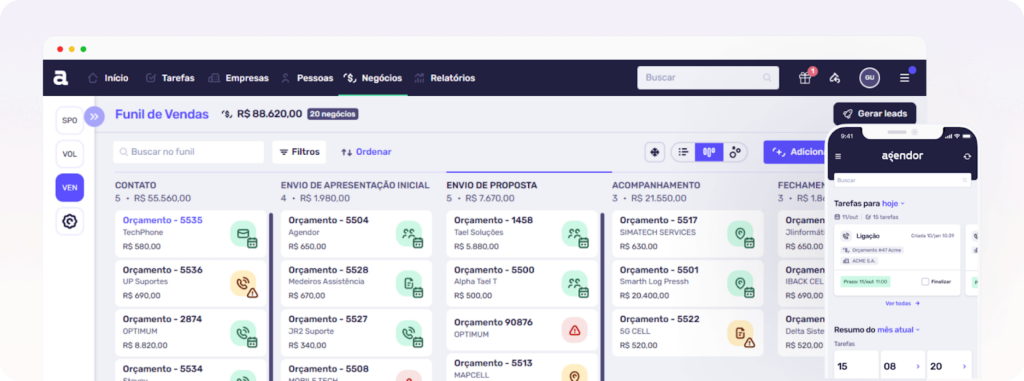
The Agendor platform
Platform overview
- CRM focused on consultative B2B sales
- Full pre- to post-sale management
- Simple, intuitive interface
Sales funnel management
- Clear visualization of funnel stages
- Identification of commercial bottlenecks
- Real-time opportunity tracking
Main features
- Task and activity management
- Complete interaction history
- Deal and pipeline control
- Custom reports
- Custom fields and processes
- Integrations with other tools
Support and lead generation
- WhatsApp Web integration
- On-site lead capture button
- Lead generation and qualification within the CRM
HubSpot CRM
HubSpot CRM is ideal for those who need to integrate marketing and sales, letting you nurture leads captured at events with smart automations.
RD Station CRM
RD Station is one of the most widely used CRM tools in Latin America. It offers advanced automation and personalization, well suited for companies looking to scale their sales processes.
3. An events platform
Finally, you need a tool that brings your whole event operation together.
A good platform closes the funnel loop. It doesn’t just receive the lead who converted — it also generates the data you’ll use to fuel the funnel for your next edition.
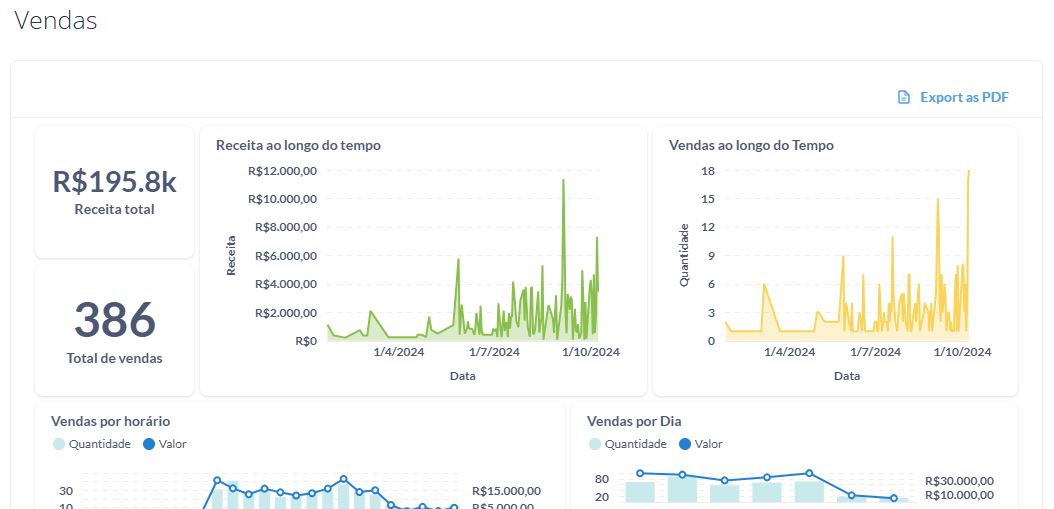
Even3’s sales analytics dashboard
When choosing one, prioritize platforms that offer:
- A customizable event website;
- Integration with email marketing and CRM tools;
- Real-time sales reports;
- Support for organizers.
Even3 is one such option. The platform brings all of this together for free, along with participant management, certificate issuance, and other automations.
That makes it much easier to build a complete sales funnel. Just take the next step: create your event for free on Even3.