If you work with events, you’ve probably asked yourself: “Am I attracting the right people?”
That question is at the heart of an effective marketing strategy. And the answer inevitably involves the concept of qualified leads.
In this guide, you’ll understand what a lead is, what makes a lead qualified, and how your events can be the most powerful tool for generating contacts that are truly valuable to your business. Let’s dive in.
What is a lead at an event?
First, it’s worth answering a very common question: what is a lead, anyway?
In marketing, a lead is any person who has shown some kind of interest in a product or service — in our case, an event.
Generally, that interest shows up as a website visit, a click on an ad, a filled-out form… The key point is that this person left a trace showing they want to know more about you.
For example, at events, this can happen in the following ways:
Interest list on the event website
When someone visits the page of an event that hasn’t opened registration yet and leaves their email to be notified when spots open, that contact is already a lead.
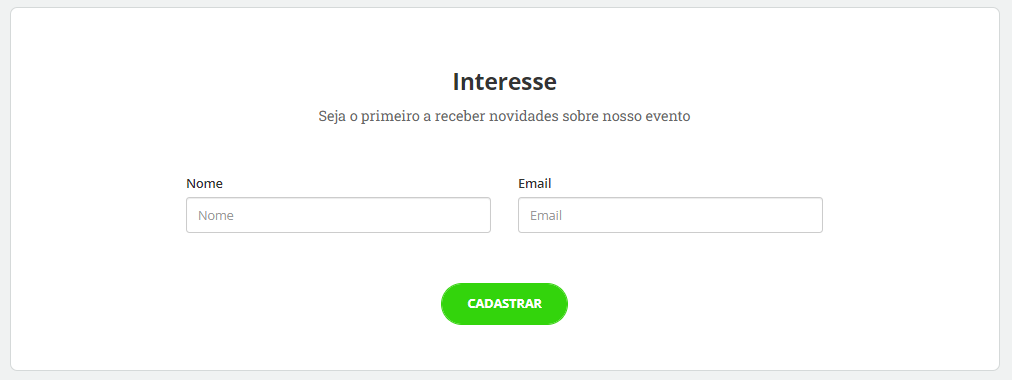
Interest Area for lead capture on the event website on Even3
Even3 offers an interest list tool integrated with the event website, so organizers can automatically capture these contacts.
Registration form
Everyone who registers for an event fills out a form with valuable information: name, email, occupation, field of work, company.
These details are what make events so valuable — they act as a powerful lead-capture engine.
Lead capture by exhibitors at trade fairs
In some types of events, such as trade fairs, the main goal is to generate leads for organizers and exhibitors.
In this case, booths are true lead-generation machines.
That’s why it’s worth using apps that allow contacts to be captured quickly and in real time.
For example, with Even3’s Lead Collector, exhibitors can scan attendee badges and capture contact data quickly, easily, and paper-free.
The result? An organized list of people who showed interest directly in your product or service.
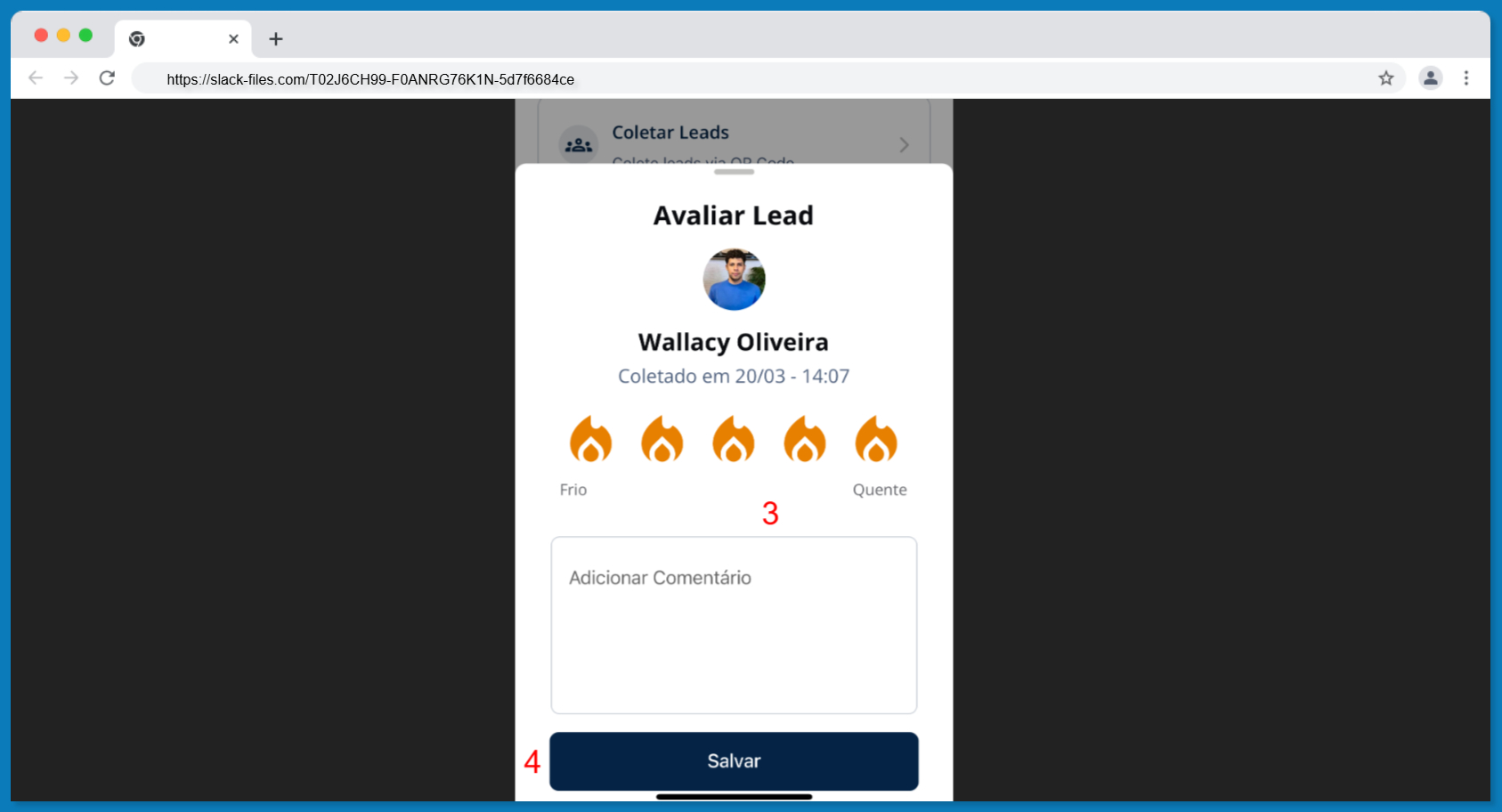
Even3 lead collector screen
What are qualified leads?
Now that you know what a lead is, it’s time to understand what makes a qualified lead so different (and valuable).
A qualified lead is a contact that, besides showing interest, has a profile and intent that match what you offer.
In other words: it’s the right person, at the right time.
For example: imagine you organize a medical conference aimed at cardiology specialists.
All registrants are leads, but a cardiologist with 10 years of experience, working at a major hospital and looking for professional development, is a qualified lead.
A first-year medical student, though interested in the topic, may not yet be at the ideal stage of purchase or engagement for your product or service.
In short, qualifying a lead takes into account criteria such as:
- Demographic and professional profile: job title, field, industry, company size
- Intent: is the lead just researching, or already considering a purchase decision?
- Timing: are they at a stage in their lifecycle where it makes sense to reach out?
- Engagement: do they interact with your content, open your emails, return to your site?
The more these criteria align with your ideal target audience, the hotter the lead. Yes, that term is used too.
Hot, warm, or cold leads? What does that mean?
Within qualified leads, there’s another useful classification: temperature.
It indicates how close that contact is to making a decision. In other words, how likely are they to convert into a customer?
- 🔥 Hot lead: High engagement, ready (or nearly ready) to act. This is someone who visited your booth with a real need, requested a proposal, or has attended previous editions of your event. Top priority for contact.
- 🌤️ Warm lead: Has the right profile and interest, but is still evaluating. Needs relevant content, a good reason, or the right moment to move forward. Worth nurturing consistently.
- 🧊 Cold lead: Left a contact, but is still far from deciding. Don’t ignore them, but keep a light touch presence. The right timing may come.
Knowing the temperature of each lead helps you prioritize who to talk to first, as well as how to approach each person.
What differentiates a qualified lead from an unqualified lead?
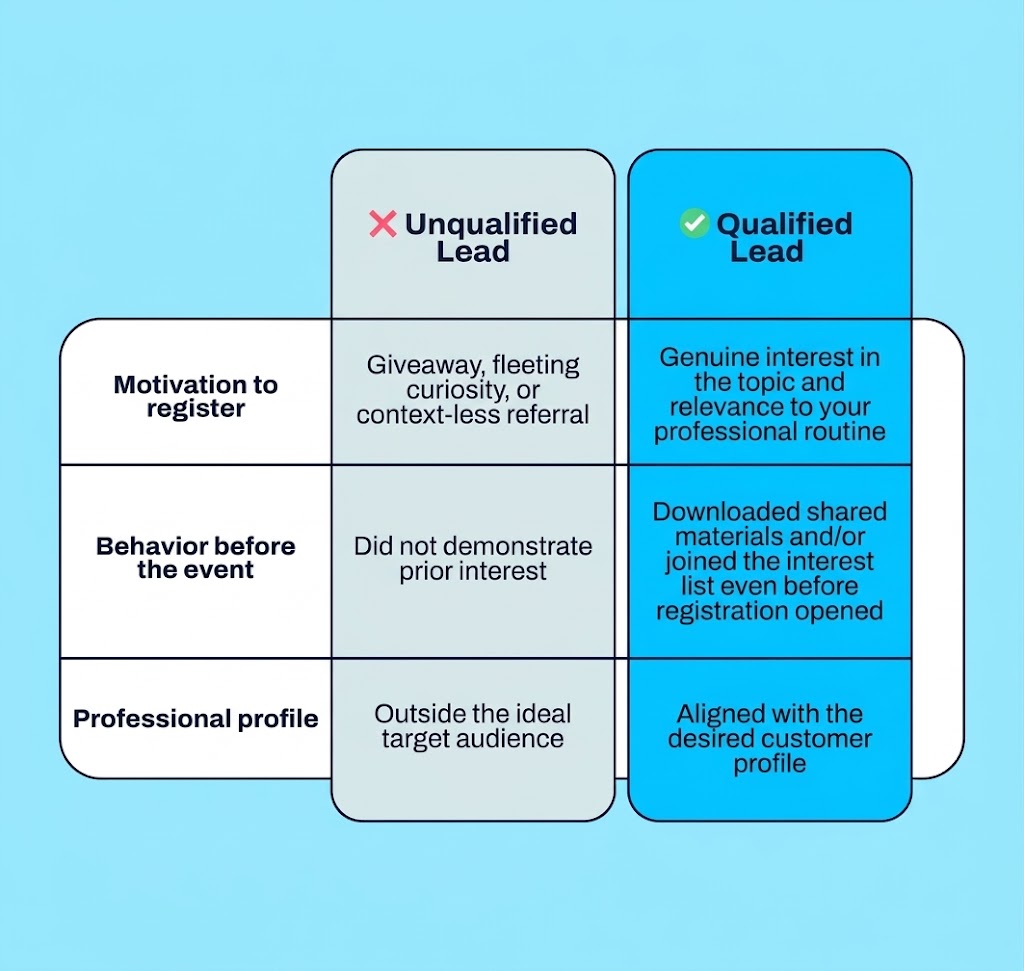
The good news is that events, by nature, already act as a filter.
After all, anyone who dedicates time (and often money) to attending an event on a specific topic usually has a genuine interest in that subject.
That alone is already a powerful indicator of qualification.
But it gets even better when you combine this natural filter with the data collected through the registration form. That way, it becomes even easier to identify which leads deserve priority attention.
How to generate qualified leads: 5 steps
1. Clearly define your target audience
Before taking any action, know exactly who your event is for.
The more specific the ideal attendee profile is, the more targeted your marketing actions will be — and the more qualified the leads you’ll attract.
2. Create relevant content to attract the people who really matter
Articles, videos, ebooks, social media posts, and emails that address your target audience’s challenges and interests bring the right people to you.
3. Use strategic registration forms
The registration form is one of the most powerful tools for qualifying leads.
Look for a tool that lets you sell tickets securely, while also customizing registration questions and collecting the information you need to segment and prioritize contacts.
4. Activate the interest list before registration opens
If your event doesn’t have open registration yet, don’t waste time!
Use an interest list tool to capture contacts from people who have already shown curiosity about the event. These leads arrive with a very high level of intent.
5. Follow up right after the event
The hottest lead is the one who just attended your event. So take advantage of that moment of high engagement to send a thank-you email, share materials, and start a conversation.
Is it worth buying qualified leads?
Generating qualified leads can be a lot of work. That’s why some people sell lead databases with names, phone numbers, and/or emails for contact.
But buying lead lists is not a good practice, and it rarely works.
The problem is that the contacts in a purchased lead database didn’t choose to receive your communications, which means email open rates are low. As a result, response rates are even lower, and the risk of being marked as spam is high.
On top of that, there’s an ethical and legal issue: most countries now require explicit consent for the use of personal data under privacy laws such as the GDPR.
Buying leads may seem like a shortcut, but it usually results in wasted time and money, plus damage to your brand’s reputation.
The good news? You don’t need that shortcut.
Events are proven to be one of the most effective ways to generate qualified leads organically and with consent.
People who register for, attend, and interact with your event do so of their own free will. And that’s worth gold in terms of lead quality!
I have qualified leads. Now what?
Congratulations! If you’ve made it this far with a list of qualified leads captured at your event, you’re at a very special point in your marketing journey.
But having the contact isn’t the end of the journey — it’s the beginning.
The next step is to nurture these leads, meaning cultivate the relationship with the right content, context, and timing until they’re ready to take the next step.
Here’s how to do it in practice:
- Act fast after the event. In the first 24 to 48 hours, engagement is at its peak. Send a thank-you email with the attendee’s name, an event recap, and the materials. It’s the most important touchpoint of the whole journey.
- Segment before you communicate: Use registration form data to sort leads by job title, field, or engagement level. Different people deserve different approaches.
- Build an email sequence: Don’t send a single message and disappear. Create a series of spaced-out content pieces that go deeper into the event’s topics, answer common questions, and share materials like recordings and presentations.
- Stay active on social media: Tag attendees, share photos and moments from the event. This keeps the event’s memory alive and reinforces your brand’s authority on the topic.
- Prioritize hot leads: Reach out first to whoever showed direct interest in your product or service. If possible, do it personally, referencing the conversation you had.
- Invite them to your next event: Previous attendees are the hottest leads for future editions. Offer early access, a discount, or exclusive content. Loyalty starts here.
And you know what makes all of this much easier? Having a complete event platform that integrates registration, lead capture, interest lists, and marketing tools in one place.
Even3 is that platform.
Create your event on Even3 right now and take advantage of all the tools to capture, qualify, and nurture your leads — from the first click on your site to the post-event follow-up.