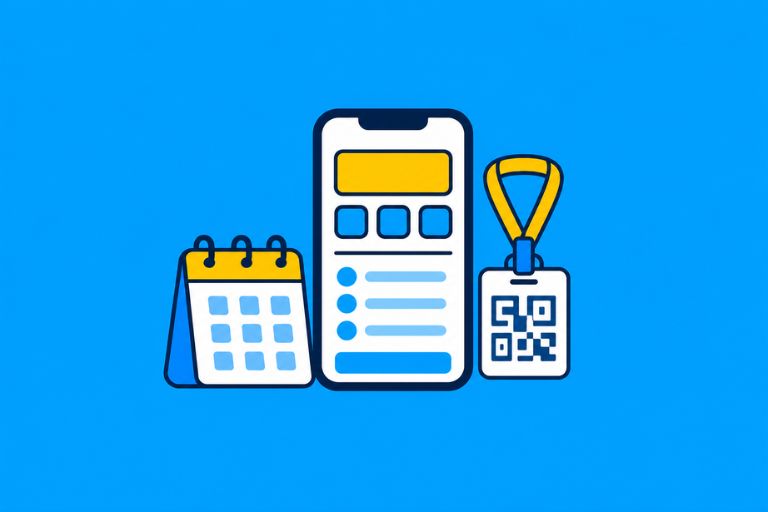
A congress app is a solution that brings information, communication, and operational tasks together in a single environment. For those who need to coordinate registrations, schedules, credentialing, speakers, and attendees, this centralization reduces the back-and-forth between spreadsheets, messages, and documents that aren’t always up to date.
Besides making the team’s routine easier, this resource improves the experience for attendees: the agenda is accessible, notices arrive at the right time, and questions get answered faster. Want to understand how to turn a phone into a support hub for the whole operation? Keep reading and see what to organize before, during, and after the congress.
Why use an app to organize a congress?
A congress combines several operations happening at once. While one person updates the schedule, another answers attendees, tracks registrations, or guides volunteers.
When each activity happens in a different tool, the team loses time looking for the correct version of a piece of information and risks communicating conflicting data.
A congress app works as a central source of reference. Instead of sending a new file every time a room changes, the organization updates the content in one place.
Attendees, speakers, and staff end up consulting the same schedule, which reduces noise and repeated requests.
This centralization also brings more agility when the unexpected happens. Did a talk run late? Did a workshop’s room change? A notice through the app can reach the affected audience without relying on posters, side groups, or forwarded messages.
Technology doesn’t replace planning, but it speeds up how the plan gets executed.
For attendees, the advantage is just as practical. They carry the agenda, access instructions, activity information, and interaction channels on their phone.
This way, they make decisions with more autonomy and need to rely on the information desk less often.
What does a congress app need to have?
Choosing features should start from the audience’s actual journey, not from how many features are available. Think about what attendees need to do from confirming registration to receiving post-event materials. Then identify which actions can be simplified in the mobile environment.
Updated schedule and personalized agenda
The schedule should show times, locations, formats, speakers, and activity descriptions. In congresses with parallel tracks, filters by topic or format help attendees find the content they want.
A personalized agenda lets each person select talks, panels, and workshops, building their own itinerary.
Changes need to show up quickly. So, define who can edit the schedule and set up an approval flow.
Before publishing any change, confirm the time, room, and audience affected.
Essential information and a map
The app should answer the most common questions: where is check-in, what are the opening hours, how to access the internet, where to find support, and what rules apply to each activity.
A simple map can point out auditoriums, rooms, restrooms, the food area, and sponsor spaces.
Organize this content by priority. Information used on the day should be just a few taps from the home screen.
Long policies, rules, and additional materials can sit in secondary areas, as long as they’re easy to find through navigation.
Notifications, interaction, and accessibility
Notifications are useful for urgent notices, reminders, and changes. However, too many messages will make attendees turn the feature off.
Set criteria: a notice needs to be relevant, targeted to the right group, and carry a clear action. If a message can wait, publish it in the news section instead.
It’s also worth watching legibility, color contrast, button size, and label clarity. A good congress app should make it easy to check information in busy environments, including for people with different levels of comfort with technology.
How to organize a congress through the app, step by step?
The best time to set up the app is before the final schedule is announced. That way, the team can review content, test access, and assign responsibilities without the pressure of the days right before the congress. Use the steps below as a roadmap you can adapt to the size of your event.
1. Map the attendee’s journey
List the touchpoints they’ll have with the congress: discovery, registration, choosing activities, arrival, check-in, participation, and post-event. This map reveals what information needs to be available at each stage.
2. Set measurable goals
Do you want to reduce lines, cut down on support questions, increase participation in activities, or centralize notices? Pick two or three indicators, like average entry time, the volume of repeated questions, and how many people build a personalized agenda.
3. Register the base content
Enter the visual identity, description, contacts, address, map, FAQs, and policies. Then, register speakers and activities using a consistent format. This avoids incomplete descriptions or names presented in different ways.
4. Integrate the operation’s data
When registration, schedule, and credentialing talk to each other, the team cuts down on duplicate data entry. A registered attendee can be identified at check-in, linked to the activities they chose, and counted in attendance tracking.
5. Assign roles and permissions
Indicate who updates the schedule, who sends notices, who monitors interactions, and who makes decisions in critical situations. Keep a small number of people with permission for sensitive changes, but prepare backups for the busiest times.
6. Test it as an attendee and as an organizer
Simulate a registration, look for a talk, build an agenda, find the map, and check a notification. Then, reproduce scenarios like a room change, an attendee with no connection, and a credential that can’t be found.
7. Guide your audience before the event
Send short access instructions, explain the main features, and let people know where they can find in-person support. A short video or a sequence of images can reduce anxiety for those who aren’t familiar with the tool yet.
How does the app help with credentialing and on the day of the event?
The day of the congress carries the highest operational risk. Attendees arrive at the same time, the team fielded questions, and any slowdown at the entrance turns into a line.
The app reduces this impact when it lets you look up registrations and validate credentials from a phone, without relying on printed lists.
Prepare the entrance before opening the doors
Estimate the flow by time slot and size your service points accordingly. Set up a fast lane for those with their credential ready and another for issues, like incomplete registration or a registration that can’t be found.
This split keeps one slow case from holding up every entry.
Sync the data on the devices beforehand, charge the batteries, and have power sources available. If the solution works offline, test offline mode and the later syncing process.
Use attendance tracking with purpose
Besides the main entrance, check-in can also happen for workshops, sessions, and presentations that need specific tracking.
This helps confirm occupancy, validate hours attended, and produce more reliable records for certificates. Beforehand, let your audience know why attendance will be checked and at which moments.
Also create a manual contingency plan, even with all tests done. It can include a minimal exported list, support contacts, backup devices, and a procedure for logging entries once the system is back up.
Contingency doesn’t mean abandoning technology, but preventing one unexpected issue from stopping the event.
How to improve the attendee experience through the app?
A tool only creates value when the audience sees a use for it. So, it’s not enough to just enable access: features need to be introduced at the moment they solve a need.
Before the congress, highlight building an agenda; on arrival, show the credential and the map; during activities, prioritize notices and interaction.
A congress app can also support building connections. Chats, questions for speakers, and an event timeline bring people with similar interests closer together, as long as there are community guidelines and moderation.
Explain the expected behavior and provide a channel to report abuse or ask for help.
To avoid a confusing experience, write as if every screen needed to answer a question. “Where does it happen?”, “What time does it start?”, and “How do I take part?” are examples of doubts that should guide titles and descriptions.
Prefer direct sentences, complete dates, and location names matching those used in physical signage.
How Even3 can centralize this experience
This is where Even3 can help. The platform lets you organize the schedule, register activities, and gather important information for attendees.
It also offers communication and notification features to keep the audience updated.
Changes can be made directly through the platform, without the team needing to build a custom solution for the event.
This way, the organization centralizes parts of the operation and makes it easier for attendees to access information.
Among the possibilities available are an attendee agenda, a list of guests and speakers, maps of the venue and sponsors, news, and links.
Depending on the setup, interaction features like a timeline, messages between attendees, and sending questions to speakers can also bring the audience closer together and encourage networking.
Since availability can vary, confirm with the responsible team which features will be included in the project.
Before hiring, align on which sections will make sense for your audience and what the implementation timeline will be.
How to choose the best solution for your congress?
Start by comparing needs, not feature showcases. An academic congress with paper submissions may require a different structure than a corporate networking event. Note what’s essential, what would be nice to have, and what won’t be used this edition.
During the tool’s demo, ask to run real tasks. Update a room, send a notice to a group, look up an attendee, and simulate offline access.
How easy that routine feels matters more than a long list of features your team won’t be able to configure.
Also evaluate:
- integration between registration, schedule, attendance, and certificates;
- how it works across different phones and operating systems;
- the ability to update content without coding knowledge;
- access controls and permissions for the team;
- support available before and during the congress;
- customization options consistent with the event’s identity;
- useful reports for evaluating results and planning the next edition.
Finally, consider the implementation timeline. Gathering texts, images, agenda, and rules requires review, even when the technology is simple. Build a schedule with dates for setup, internal validation, a pilot test, adjustments, and communication to the audience.
So, the sooner a congress app enters your planning, the greater its contribution to an integrated operation.
Organizing a congress from a phone starts with centralizing data, but gains value when it connects planning, credentialing, communication, and the attendee experience.
Map the journey, choose only useful features, test real scenarios, and prepare your team to act on the unexpected too.
The next step is to list your edition’s needs and turn each one into a clear feature within the app.