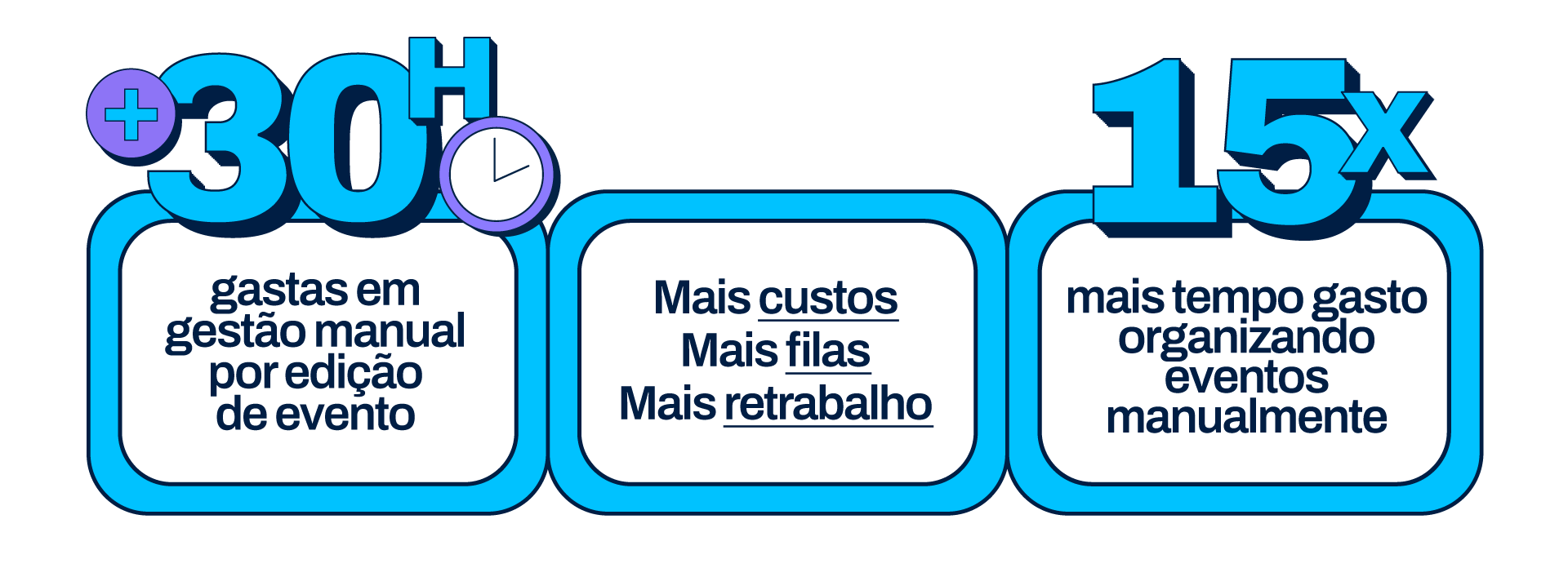
You’ve probably already noticed that the routine of anyone who organizes events manually carries a hidden cost: time.
In general, this cost multiplies in the same proportion as the event grows. The more registrants, the more work gets added to the event organization.
As the numbers show, running an event by hand is possible. Until it isn’t!
Have you ever imagined what happens when an event needs to send out more than 15,000 certificates? That’s already happened at Even3!
But the solution wasn’t to overload organizers — it was investing in automation technologies capable of cutting the time spent organizing events by almost 93%.
Want to know how to do that, when the best time is, or whether it’s worth it for your event? Then follow this article:
- Where does the most time get wasted in event organization?
- The impact of automation on event organization
- Case study: what changes in practice
- How to reduce time spent on event organization: a practical checklist
- Is it worth using an events platform?
Where does the most time get wasted in event organization?
First, to know where to act, you need to break down the time lost by activity.
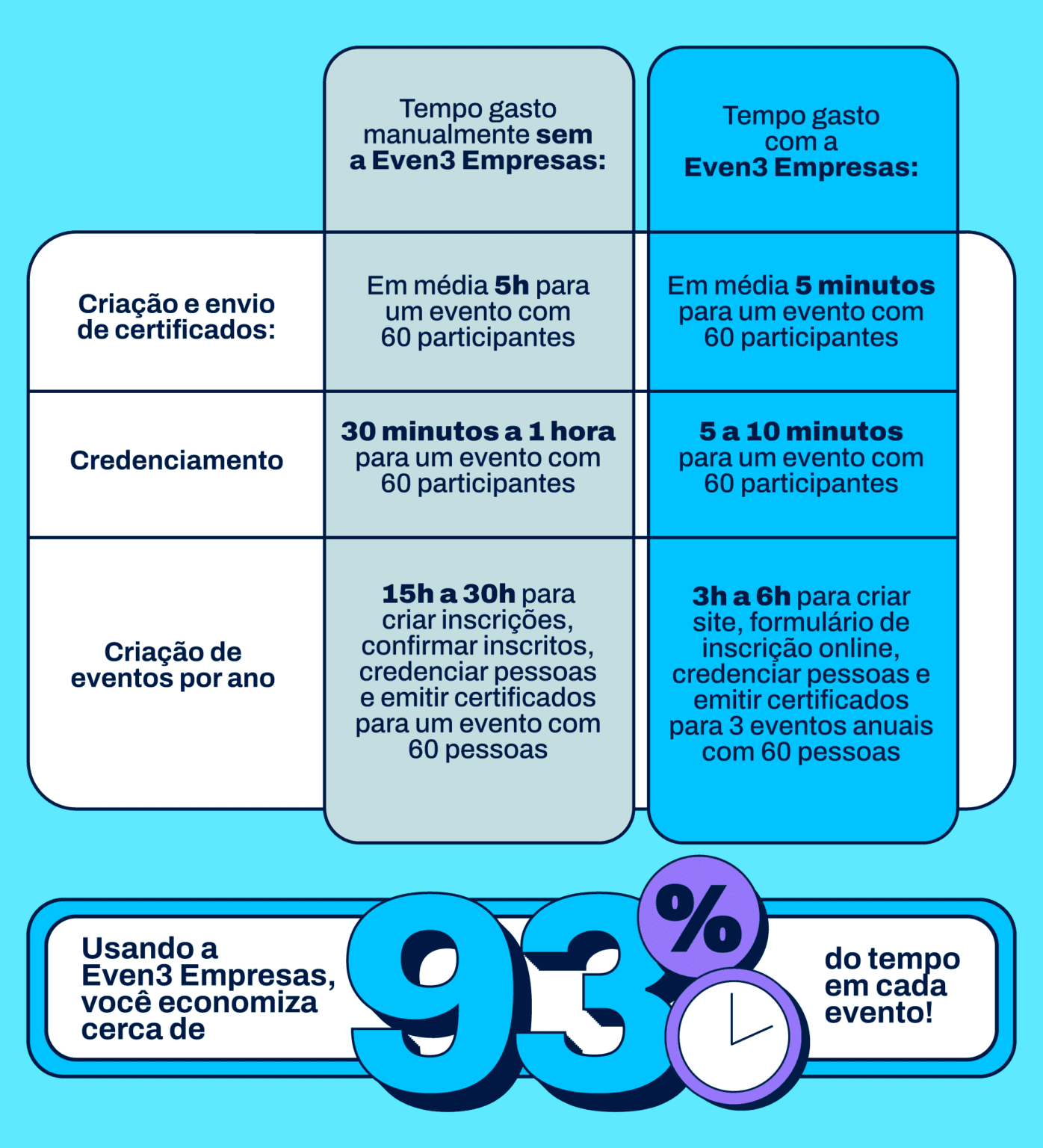
Overall, data gathered from corporate event organizers shows a consistent pattern:
Certificates deserve special attention: at an event with 60 attendees, generating, naming, sending, and confirming receipt of certificates individually consumes between 3 and 5 hours of human work. For events with more than 200 people, that number can double.
On top of that, in-person check-in is another critical bottleneck: lines at the entrance create a negative first impression. This overloads the team during the first 30 to 60 minutes of the event, exactly when attention should be somewhere else.
💡 Networking and data collection:
Beyond the numbers mentioned above, one often-overlooked point is the cost of collecting lead data at events.
Without a system like a Lead Collector, such as Even3’s, teams fall back on physical badges, handwritten notes, and business card exchanges.
This process may have worked in the past, but it can result in incomplete, illegible, or lost data. With the use of technology, a simple QR code scan can automatically build a contact list and prevent lost information.
The impact of automation on event organization
Finally, the comparison between the manual model and the use of a platform like Even3 isn’t just qualitative. The numbers speak for themselves:
| Activity | Manual | With Even3 |
|---|---|---|
| Certificate issuance | up to 5h | automatic |
| Check-in | up to 1h in line | QR code — seconds |
| Registration management | manual spreadsheets | real-time dashboard |
| Lead collection | cards and handwritten notes | digital Lead Collector |
| Post-event reports | 3 to 6h of compiling | generated automatically |
| Communication with registrants | manual emails | automated flows |
In short, automation doesn’t eliminate the work of organizing an event. But it eliminates the work that shouldn’t be done by people!
The result is something many organizers have already experienced:
“The platform helped us a lot. Everything was really intuitive! And the support team helped us from the start. This time we just had to press a button to send out more than 15,000 certificates” — Pricila Magalhães, Festival do Conhecimento – UFRJ
“You helped us avoid huge lines at the event. We actually timed it, and our maximum wait time was 6 minutes“ — Pricila Magalhães, Festival do Conhecimento – UFRJ
Case study: what changes in practice
As you can see, automation doesn’t just create a theoretical change. That’s what makes it worth it!
In real cases, like the partnership between Fundação Getúlio Vargas and Even3, adopting an events platform that automates tasks scaled up the institution’s results.
In practice, they reached the following milestones:
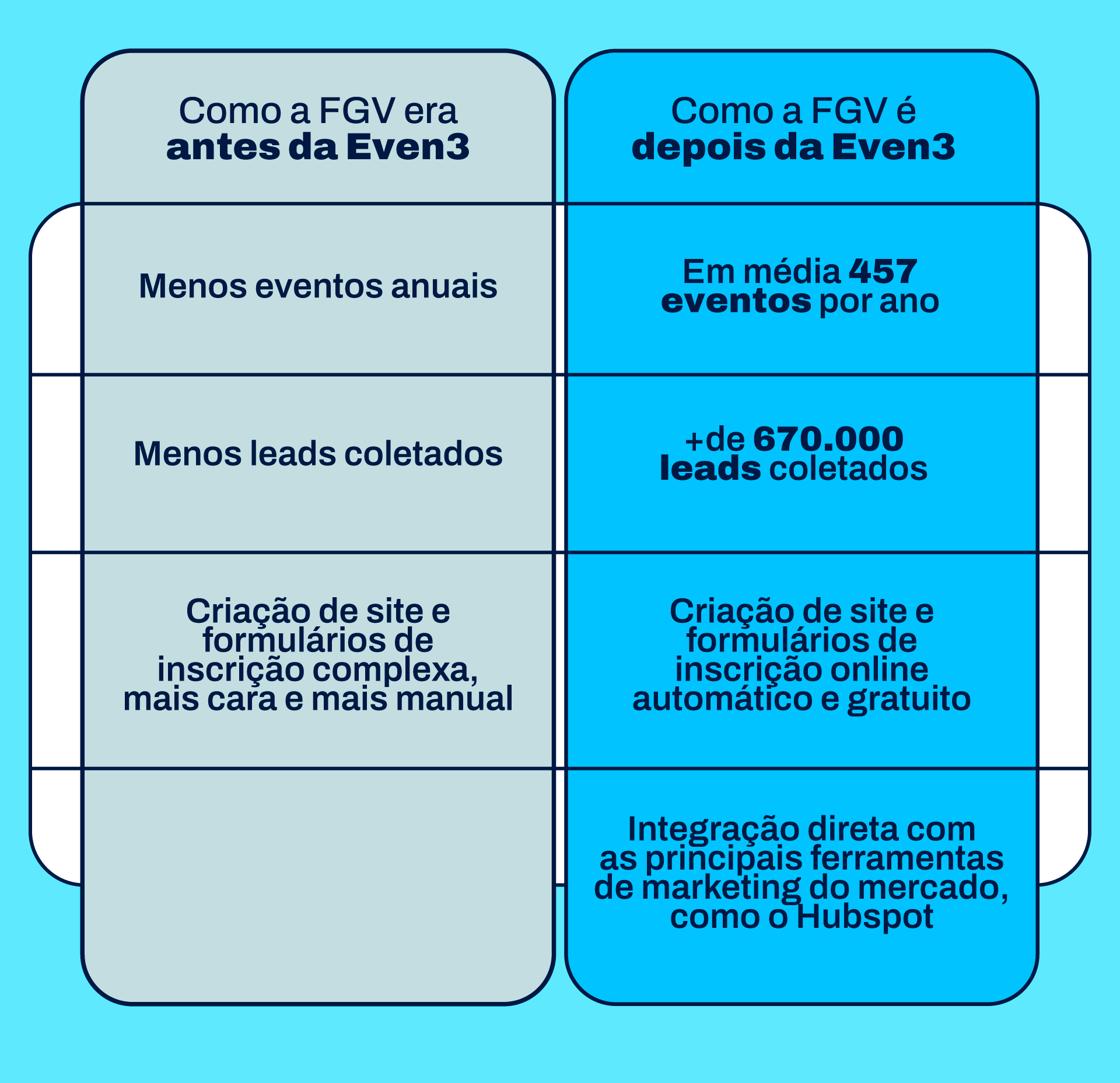
Basically, when you automate, you free up capacity. That capacity then turns into growth.
How to reduce time spent on event management: a practical checklist
If you want to start recovering hours of work as early as your next editions, these are the levers with the highest immediate return:
- Automate registration. Replace external forms and spreadsheets with an integrated registration page that updates the attendee list in real time;
- Make certificate issuance automatic. Use a system that generates, personalizes, and sends each certificate without human intervention;
- Adopt digital check-in. A QR code per attendee eliminates lines, reduces errors, and frees up the support team for other tasks during the event;
- Deploy a Lead Collector. Capture networking data in a structured, digital, and trackable way without losing valuable contacts on paper cards;
- Centralize management on a single platform. Registration, payments, communication, check-in, and reports in one place eliminates rework caused by fragmented data;
- Integrate with your CRM and marketing tools. Send event data straight into your funnel, without manually exporting spreadsheets.
Is it worth using an events platform?
Yes! And the most honest question isn’t whether it’s worth it, but how much longer you can keep going without one.
If your event has more than 50 attendees and involves certification, check-in, or lead capture, the operational cost of the manual model already exceeds the investment in a dedicated platform.
Even3 was built specifically for this scenario: events that need to grow without the team’s effort growing at the same rate.
If you want to save 93% of your time organizing an event, then it’s worth using a free platform like Even3.