Have you ever stopped to think about everything a person goes through, from the moment they discover your event to the day they tell friends about the experience? That path has a name: the participant journey.
Although we’re often not aware of it, understanding it and taking control of it can guarantee your event’s success without needing big financial investments.
In fact, some of the benefits are quite clear, such as increased attendance, smarter resource prioritization, and customer loyalty, among others.
Ever imagined having all of that in your event? Then see how to apply this knowledge in practice 👇
What is the participant journey?
The participant journey is the path a person follows through every stage of their relationship with an event.
It begins even before registration, when someone discovers that the event exists, and continues throughout the whole experience and even after it ends.
This concept is inspired by the well-known “consumer journey,” widely used in marketing. The difference is that, in the context of events, the goal isn’t just to sell a ticket, but to provide a positive experience from start to finish.
When this journey is well planned, the participant:
- easily understands the value of the event;
- finds few difficulties when registering;
- receives clear information before the big day;
- has a pleasant experience during the program;
- maintains a relationship with the organization after the event.
The result is a more satisfied, more engaged audience that’s much more likely to recommend your event to other people.
What are the stages of a participant’s journey at an event?
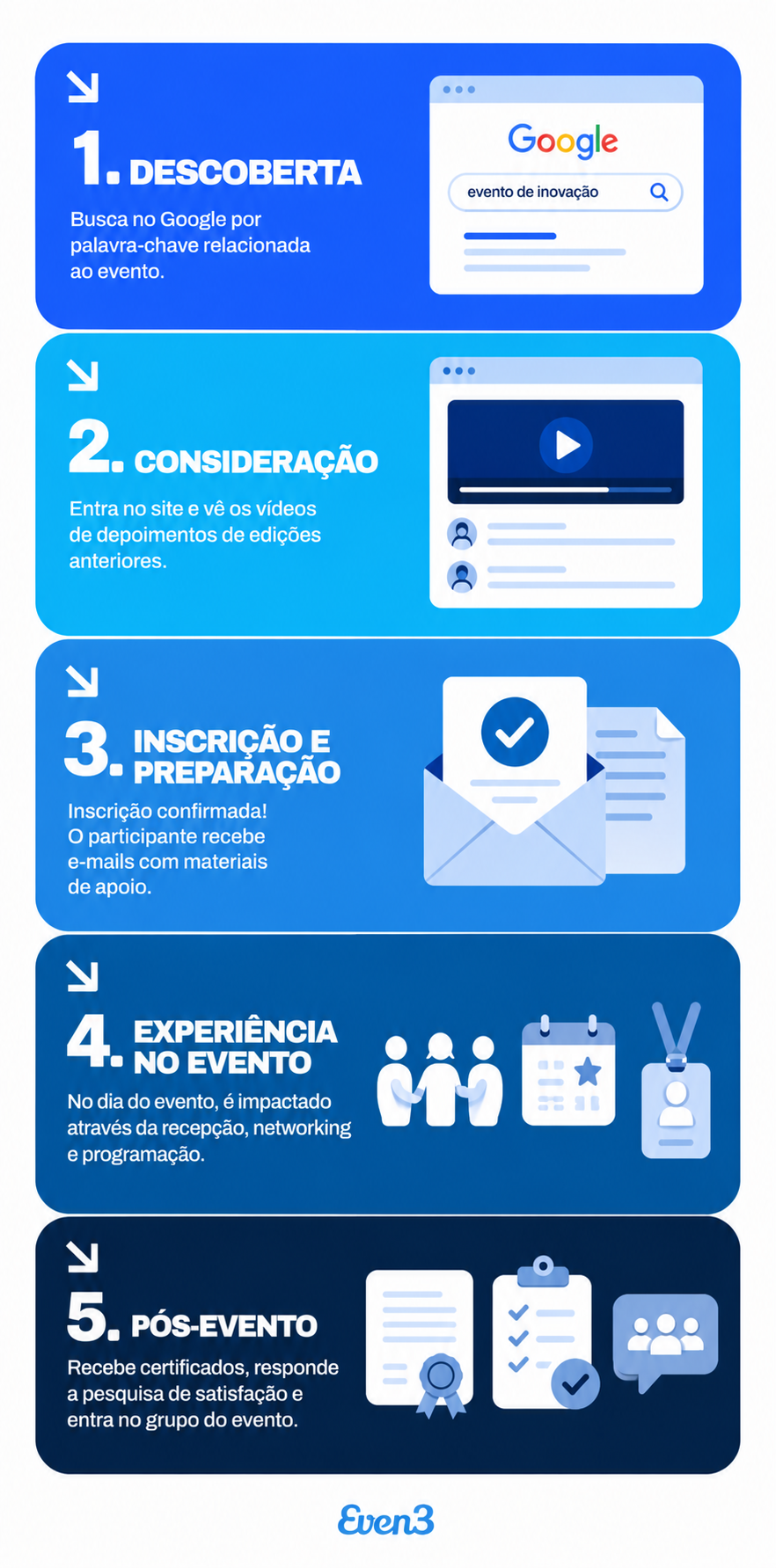
Although each event has its own particularities, it’s possible to organize the participant journey into five main stages. Let’s go through them:
1. Discovery
This is the person’s first contact with your event. It can happen through social media, a friend’s recommendation, a paid ad, email marketing, or even a Google search. At this stage, the goal is to spark curiosity and clearly show what problem your event solves or what transformation it provides.
2. Consideration
Here, the person already knows the event exists, but is still deciding whether to attend. So they compare options, read testimonials, check the schedule, weigh the investment, and think about whether this is the right time for them. This is the moment to clear up doubts and reinforce the benefits of attending.
3. Registration and preparation
The person decides to attend and registers. From here on, a fundamental and often overlooked phase begins: preparation. Email confirmations, venue and time information, practical guidance, and even small reminders help keep enthusiasm alive until the day of the event.
4. The event experience
This is when everything comes together: the reception, the infrastructure, the content, interaction with other attendees, team support, and all the small details that make up the in-person or online experience. This is where the expectations built up in the previous stages become reality.
5. Post-event
Many people believe the journey ends when the event is over, but this is actually when loyalty is built. Sending thank-you notes, certificates, supplementary materials, and satisfaction surveys makes all the difference so the person keeps a good memory and wants to attend future events.
How to impact attendees throughout the journey?
Now that you understand the stages, let’s get to what really matters: how to act at each one to positively impact whoever attends your event.
Know your audience
First of all, you need to know your audience.
That’s because the more you understand who attends the event, the easier it becomes to create relevant experiences and communications.
So, ask yourself:
- What are their biggest doubts?
- What do they expect to learn?
- What difficulties do they usually face?
These answers help you make better decisions at every stage.
At discovery
Moving into the stages, the ideal is to build experiences that create the “wow” effect, known for that feeling of “this event exceeded my expectations.”
By itself, that already makes your event stand out.
So, for example, at the discovery stage, put extra care into the first contact with the event.
Here, the participant should recognize your event: seeing attractive visuals, messages that make sense together, and having a fast, secure experience on the website.
How to improve this touchpoint:
- make clear what problem the event solves;
- highlight the main benefits of attending;
- use consistent images and visual identity;
- make it easy to access key information.
How to create the WOW effect:
Instead of just announcing the date and schedule, tell stories, show results from previous editions, share testimonials, and help the participant imagine what it would be like to live that experience.
Communication before the event
There’s a very important period between registration and the big day.
This is the stage when doubts and expectations arise, and there’s even the risk of the participant forgetting about the event.
How to improve this touchpoint:
- send reminders close to the date;
- share schedule updates;
- provide times, location, and practical guidance;
- respond quickly to questions.
How to create the WOW effect:
Send content that prepares the participant to make the most of the experience, such as tips from speakers, introductory materials, or networking suggestions even before the event begins.
That way, the feeling is that the event is already worth it, giving more confidence about attending.
The event experience
This is where the participant experiences everything that was promised.
First impressions matter a lot, such as the reception, contact with other people, and check-in.
How to improve this touchpoint:
- speed up check-in;
- keep to the scheduled times;
- have a team ready to guide people;
- clearly signpost the spaces;
- offer a well-organized program;
- make it easy to ask questions and interact;
How to create the WOW effect:
Create unexpected, memorable moments. It could be an interactive activity, welcome gifts, a group dynamic, an Instagram-worthy space, networking opportunities, or exclusive content that wasn’t originally planned.
In the end, it’s these small surprises that tend to be remembered for a long time.
Communication after the event
The experience doesn’t end when the last talk finishes.
In fact, this is a decisive moment for strengthening the relationship with those who attended.
How to improve this touchpoint:
- send certificates quickly;
- make presentations and recordings available;
- share a satisfaction survey;
- thank attendees for participating.
How to create the WOW effect:
Go beyond the basics. Share a summary of the main takeaways, send supplementary materials, offer early access to the next edition, or keep an active community so attendees can keep exchanging experiences.
In short: impacting the participant journey doesn’t require big investments, but rather paying attention to the right details at the right time.
How do you know if your participant journey is good?
Finally, when you plan the entire participant journey, you reduce friction, strengthen the relationship with your audience, and increase the chances that they’ll come back for future editions.
And there are indicators that show whether you’re doing a good job or not, such as:
- Registration conversion rate: how many people who showed interest actually registered? A low rate may indicate friction in the discovery or consideration stages;
- Check-in rate: how many registrants actually attended the event? This number reveals how well the preparation stage is engaging people until the big day;
- Satisfaction surveys (NPS): asking directly “how likely are you to recommend this event” is one of the simplest and most effective ways to measure overall perception of the experience;
- Engagement during the event: participation in activities, questions, interactions, and attendance at sessions show whether the content and program are truly connecting with the audience;
- Return rate: how many people who attended one edition come back for the next ones? This is perhaps the most valuable indicator of all, because it shows real loyalty.
Tracking these points helps you understand, based on data rather than just impressions, where the participant journey is working well and where there are still opportunities for improvement.