
Not sure which type of event to organize? It’s very common to run into this question!
After all, each event format has its own characteristics, specific goals, and different formats.
That’s why it’s essential to understand the real benefits each one offers.
So in today’s article, we’ve put together the 20 main types of events in the market, with practical examples of use and their advantages.
This way, it’ll be easier for you to choose the best format to organize.
Types of academic events
In general, academic events have as their main goal the spread of knowledge.
They encourage scientific research and the exchange of experiences among students, professors, and researchers.
Since they’re quite similar, people often confuse the different types of academic events.
But using the right format can boost your results. So let’s get to know them:
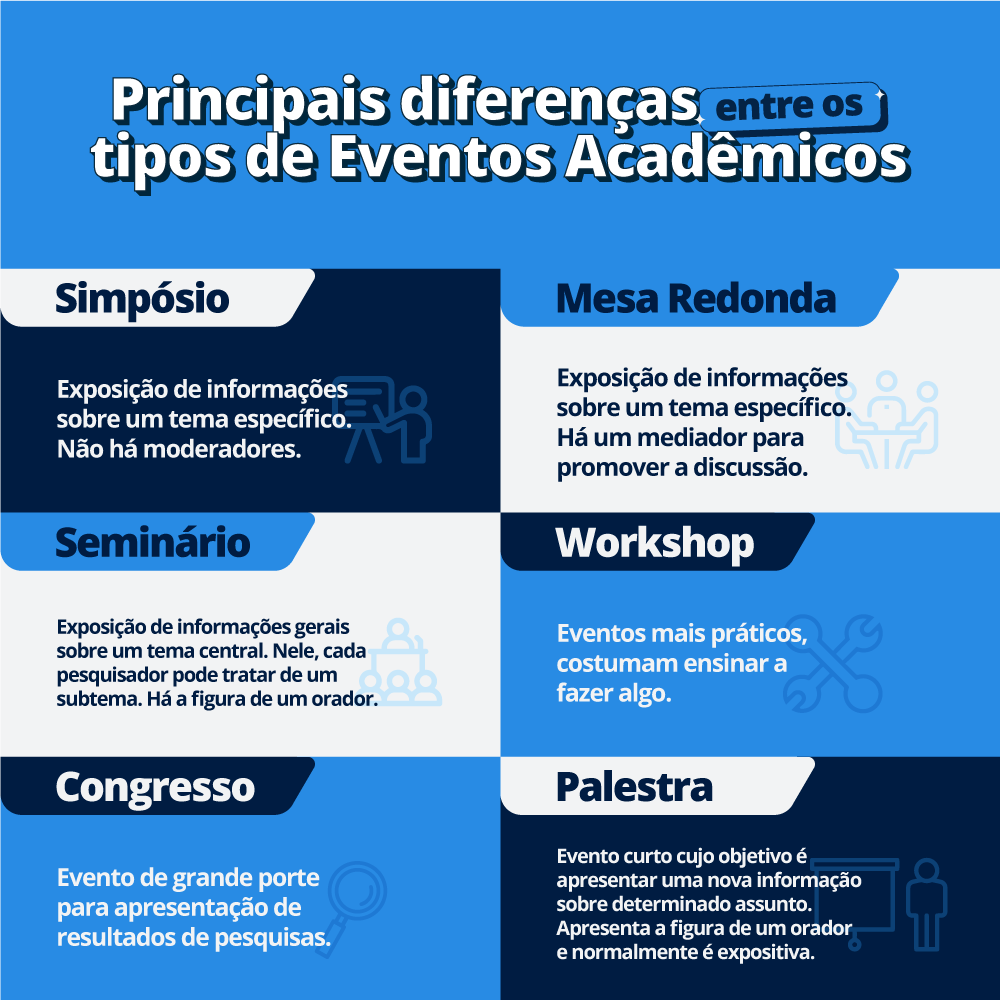
1. Congress
A congress is one of the most common types of events.
Its goal is to debate and draw conclusions about a central topic.
“A congress is the gathering where experts deliberate on questions of shared interest or present studies, new findings, etc.”
Characteristics of a congress:
- It’s a formal event
- It’s held periodically
- It’s a highly complex event
- It has its own rules and bylaws
Congresses are generally promoted by professional associations and bring together professionals and specialists who share a common interest and work in the same field.
Congresses can be regional, national, or international.
And within a single congress, several types of activities can take place, such as round tables, conferences, symposiums, talks, panels, and more.
Main benefits of a congress:
- A stimulating environment for networking;
- Visibility for researchers;
- Publication of papers;
- Promotes scientific collaboration.
2. Meeting
This type of event aims to discuss what’s happening in a given field and highlight what needs improvement, proposing solutions.
“It’s the gathering of people or experts to discuss a specific topic.”
In an academic meeting, people from the same professional category debate relevant, current, and sometimes controversial topics in their field.
That’s why the topics discussed at a meeting often serve as the basis for a shift in how that specific field operates.
While a congress tends to be broader, a meeting is more focused on a single professional category.
Main benefits of a meeting:
- Networking;
- More focused debate;
- Brings together professionals working in the same field;
- Drives improvements for the market and for research.
3. Seminar
According to Capes (Brazil’s federal research funding agency), a seminar is a type of event that brings students together around a topic presented orally. Usually, this topic is tied to research being developed by those students.
In other words, a seminar works like a debate, aiming to explore all the aspects and variables of a subject.
Unlike a meeting, a seminar is only about discussing the situation — no decisions are made about it.
It also differs from a talk, since the central topic is debated by two or more presenters.
So the discussion isn’t centered on a single person’s opinion.
This allows for a greater exchange of experiences, since different points of view can be shared with the audience.
The session is usually divided into three parts: presentation, discussion, and conclusion.
Main benefits of a seminar:
- Ideal for training and teaching;
- Deep dives into topics and presentation of ongoing research;
- Exchange of experiences among peers.
4. Webinar
A webinar is basically an online version of a seminar.
Its name literally means an “online seminar,” and it can be either recorded or live.
It’s usually used by educational institutions to share knowledge, promote interaction, and build authority on a topic.
For example, in event kickoffs, expert content sessions, or open classes to attract new registrations.
But to organize one, you need to collect registrations online and stream it on a stable, secure platform. This way, you avoid distractions and unwanted intrusions.
Main benefits of a webinar:
- Accessible to attendees from anywhere;
- Saves on logistical resources;
- Highly scalable;
- Can be reused as post-event nurture content;
- Makes it easier to collect qualified leads.
5. Round table
Round tables are usually part of the program of larger events, like congresses.
This type of event aims to promote debate and raise questions about a topic.
That’s why the topic discussed tends to be controversial and of public interest.
At a round table, audience participation is quite active. People are encouraged to defend points of view and ask the experts questions.
That’s why having someone coordinate the session is essential to keep things in order.
This coordinator, who can also be called the table’s chair, acts as a moderator.
So they’re responsible for keeping the discussion focused on the main topic.
Round tables usually bring in experts on the subject being covered.
Besides presenting their point of view on the topic, they often have to work within a time limit for their remarks.
This format aims to give the audience a broad perspective that sparks reflection and builds consensus on the topic being discussed.
Main benefits of a round table:
- Dynamic format with active audience participation;
- Direct connection between experts and the audience;
- Open debate on thought-provoking topics;
- Ideal for the programs of larger events.
6. Panel
A panel is a type of event derived from the round table.
However, in this format, the experts — who are usually well known — debate the topic while the audience only participates as spectators.
So for both types of events, it’s essential to be clear about the speakers’ backgrounds and the main benefits of hearing them speak. You should promote the program’s highlights on the event’s website.
7. Symposium
According to Capes, a symposium consists of a:
“Meeting initiated by a given scientific community around a specific topic, aiming to gather results and considerations in order to advance its clarification.”
In other words, a symposium brings together researchers who want to study and discuss a given topic in order to reach further conclusions about it.
It involves an exchange of information (knowledge and experience), aiming at decision-making. That’s why it’s quite similar to a meeting.
Like a congress, it’s one of the event types that requires complex organization.
A symposium can include several conferences and multiple parallel presentations.
These presenters showcase the research they’re developing within the symposium’s central field of study.
Main benefits of a symposium:
- Facilitates specialized discussions;
- Encourages new approaches in specific fields.
8. Forum
A forum is a type of event aimed at freely debating an idea.
That’s why its main feature is audience participation.
It’s commonly part of the program at events like congresses, but it’s also very present in online events, creating a kind of open chat.
It’s the type of event for people who like to speak up and want to hear different perspectives on a subject.
Active audience participation is essential, and the audience is usually encouraged and motivated to join the discussion.
Main benefits of a forum:
- Interactive and dynamic;
- Easy to organize, without major complexity;
- Active audience participation;
- Generates diverse, collaborative discussions;
- Encourages participation even from non-experts.
9. Academic journey (Jornada)
Academic journeys are gatherings of more closely connected professional groups, usually at a regional level.
Topics of interest to the group are typically discussed periodically. It also helps integrate undergraduate students into research and outreach activities.
Ultimately, the event can lead to conclusions such as new guiding directions for research and for the profession.
Journeys can last several days, depending on the complexity and size of the event.
That’s why it’s essential to carefully build the event’s schedule and promote it attractively on your website.
Main benefits of an academic journey:
- Boosts student engagement;
- Promotes early involvement in research;
- Bridges undergraduate and graduate studies.
10. Week
Similar to journeys, “Weeks” are also academic events that promote integration.
A Week is characterized by offering a wide range of activities (forums, panels, short courses, etc.).
In short, it’s a gathering of people from the same professional category who want to discuss and learn more about topics of shared interest.
The program can vary depending on the institution and its organizing coordinators.
11. Colloquium
According to the dictionary:
“Colloquium [from the Latin colloquium.] noun. 1. Conversation or talk between two or more people. 2. A gathering of qualified people, where a specific subject is debated.”
This type of academic event creates a space for conversation among several people to debate a specific, well-defined topic.
That’s why colloquia usually feature presentations of scientific papers.
In a colloquium, the topic needs to be well structured, since its main goal is presentation or debate.
So it can be presented in different ways: as a talk, where one person addresses the audience; or as a table format, where everyone debates at the same time.
Main benefits of a colloquium:
- Presentation of papers;
- Peer contribution;
- Encourages scientific production and dissemination.
Types of corporate events
Corporate events (or business events) are usually organized by companies with the goal of promoting the brand, training employees, generating business, or strengthening partnerships. Check out some examples:
1. Hackathon
A hackathon is an event with a limited duration, which can range from a few hours to several days.
In it, multidisciplinary teams come together to solve practical challenges using technology, creativity, and innovation.
Generally, participants form groups and develop solutions such as apps, systems, or prototypes.
They respond to problems previously proposed by the organizers and often compete for prizes.
Hackathons are typically used to attract talent or invest in the development of innovations in a given field.
Main benefits of a hackathon:
- Encourages open innovation;
- Teamwork;
- Brings participants closer to the job market;
- Hands-on skill-building;
- Can lead to viable solutions that keep developing after the event.
2. Trade fairs
Trade fairs are events focused on showcasing products, services, and innovations.
They tend to bring together companies, consumers, and partners, generating great networking opportunities.
They’re also quite common for connecting suppliers with potential clients.
In these cases, they can be open to the public or restricted to professionals from a specific industry.
Main benefits of a trade fair:
- Generates qualified leads;
- Strengthens the brand;
- Opportunities to connect with other companies in the same field;
- Direct contact with the target audience;
- Launching new products in a highly targeted environment.
3. Conferences
Conferences are large-scale events that bring together experts, professionals, and enthusiasts to discuss strategic and relevant topics in a given industry.
It’s a more formal event, usually drawing a specific, more experienced audience on the topic being covered.
Conferences generally happen annually, though this frequency can vary depending on the organizing committee.
Speaking of the organizing committee, this type of event is usually organized by:
- Associations and professional organizations;
- Government agencies;
- Coalitions;
- Individual organizations.
Main benefits of a conference:
- Strengthens the company’s or institution’s image as an industry reference;
- Promotes collective learning;
- Generates high-level networking;
- Attracts coverage from specialized media.
4. Workshop
Workshops are practical, interactive training sessions. Since they’re very dynamic, they tend to work well in different formats, whether academic or corporate.
This type of event is short and focuses on developing specific skills.
That’s why it tends to be quite popular — after all, it delivers immediate application of knowledge.
But to organize a good workshop, keep in mind that this type of event needs to be geared toward a small audience.
You also need to provide the tools necessary for the hands-on portion to happen.
Main benefits of a workshop:
- Guaranteed certification and a resume booster;
- Fast, practical, and focused learning;
- A popular type of event;
- High attendee engagement.
5. Courses
People often confuse workshops and courses!
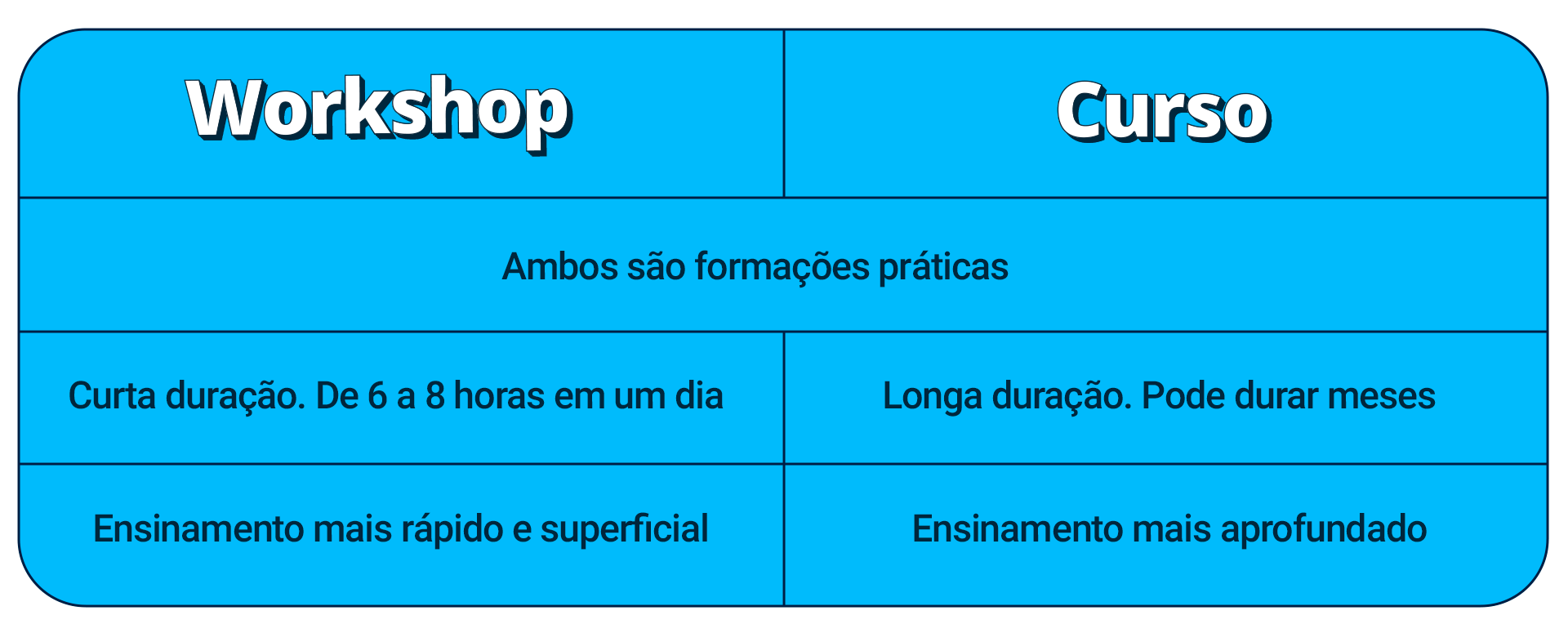
Basically, a course goes into detail on a given subject or set of topics in order to “train” or “teach how to do” something.
That’s why they can also be found in both academic and corporate contexts.
However, unlike a workshop, a course tends to be more theoretical than practical. That’s why it usually has more hours and covers the material in more detail.
For this reason, courses are also recommended for people who are still learning about the topic.
Today, many courses happen online and tend to reach a larger number of people as a result.
Main benefits of a course:
- Training and skill-building;
- Reinforces authority in the field;
- Attracts qualified leads;
- Guaranteed certification.
6. Conventions
You may have also heard of conventions!
A convention is a type of event focused on sharing results, presenting updates, or setting goals for a specific audience — for example, employees of a company or members of an organization.
Usually, in a corporate context, these events are held internally to present results.
But there are also large industry conventions, where important decisions are made for an entire sector.
Conventions are usually large-scale events with an extensive program. This can include executive presentations, as well as social and relaxation activities.
It’s also common for conventions to be held at hotels or resorts, taking advantage of their infrastructure.
Main benefits of a convention:
- Sets guidelines for specific areas;
- Generally strengthens the industry;
- Improves organizational climate;
- Reinforces company culture;
- Promotes goal alignment and encourages results-driven performance.
Trending event types
Finally, socio-cultural events always tend to have their moment.
After all, they include popular gatherings that promote community practices, faith, culture, sports, and entertainment.
Today, people are looking more and more for events that promote well-being, real connections between attendees, and meaningful experiences within a community.
Check out some of the most popular formats:
1. Spiritual retreats
Spiritual retreats are events that promote faith and connection between people.
They usually take place in locations farther from the city, to encourage rest, deeper faith, and memorable community relationships.
These events are organized by community groups or religious institutions of any faith, but they’re especially popular within evangelical communities, where they’re also known as camps.
To organize these types of events, it’s important to manage registrations, ticket sales, and check-in to ensure the safety of everyone present.
Main benefits of spiritual retreats:
- Strengthens spiritual bonds;
- Promotes self-knowledge;
- Strengthens the connection with the community;
- Attracts new members to institutions;
- Offers emotional renewal and rest.
2. Street races
Speaking of well-being, street races have arrived in full force to represent this category and are increasingly popular in major cities.
This type of sporting event promotes physical activity in an accessible, urban environment.
They’re usually organized by public institutions, companies, or sports collectives.
They also feature different categories, such as 5K, 10K, half marathon, and even full marathon.
To organize a street race, you need to secure legal permits from the local government and have logistical support in place (such as hydration stations and street closures).
You’ll also need an online registration form and a check-in platform.
Main benefits of street races:
- Encourages healthy habits;
- Strengthens the sense of community;
- Offers visibility for sponsors;
- Increases the organizer’s popularity;
- Captures leads;
- Engages diverse audiences;
- Promotes positive use of public spaces.
3. Shows and cultural performances
Shows and cultural performances are artistic events focused on entertainment.
That’s why they’re always in high demand! After all, who doesn’t enjoy a good concert or a theatrical performance?
These events can be large or small scale, with free or paid admission.
They’re usually promoted by public institutions, private producers, cultural collectives, and community organizations.
But good organization should include artistic curation, stage and sound setup, security, and effective promotion strategies.
Main benefits of cultural performances:
- Promotes access to culture;
- Expands the reach of artists and institutions;
- Generates a positive emotional impact;
- Boosts the creative economy;
- Strengthens social and cultural bonds.
How do you choose the ideal type of event?
By now, it’s clear that each type of event has different characteristics, right?
It’s important for the chosen format to align with the organizer’s goal. To do that, it’s essential to consider factors such as:
- Who can attend;
- Your goals for the event;
- The results you want to achieve;
- Available infrastructure;
- Financial resources;
- The time needed for planning;
- The content and program you want to deliver.
By understanding the particularities of each format, event organizers can make more strategic decisions and increase their chances of success.
No matter your field, events are powerful tools for connection and transformation.
Now that you know the main types of events, how about rolling up your sleeves and starting to plan yours?
If you want to make that journey easier, Even3 can help you organize any type of event you want.
Count on a platform that makes it easier to organize events with automated actions, websites, registration forms, and much more.