
Are you on the team that organizes seminars, or the team that presents them? Academic life is divided between these two groups. You might move between them, but one thing is certain: there’s no escaping the seminar!
After all, it’s genuinely used as a learning method.
Teachers hold seminars so that students can pass content along to other students.
Researchers love this type of event to share their research results. And research projects are almost always announced through academic seminars.
That’s why they’re always in demand and organized in the scientific community. And there are some solutions that can make them even more complete for this audience.
Learn more about:
- What is a seminar?
- What is the structure of an academic seminar?
- How do you put on a seminar?
What is an academic seminar?
A seminar is an academic event focused on oral presentation. But it can also be used as a teaching tool at times. That’s why we also call it an academic seminar.
In practice, a seminar sets out to analyze and/or explain a given subject. That’s why it’s characterized by a speaker’s presentation followed by discussion with the audience.
So it aims to convey knowledge and encourage debate, but it doesn’t involve any decision-making.
This type of event is usually led by one or more specialists.
If more than one person is presenting the topic, a coordinator may be present to keep things organized.
When used correctly, seminars are a great opportunity to promote active learning.
In that case, students themselves research, understand and prepare presentations in order to pass the knowledge on to other students.
Understanding the structure of an academic seminar
An academic seminar is generally divided into 3 stages. They are:
- Presentation stage: Carried out only by the speakers, in which the topic is presented to attendees and set up for the next stage.
- Discussion stage: Involves active audience participation, going deeper into the topics covered.
- Conclusion stage: The final stage that ties together and summarizes all the information discussed in the previous stages.
This type of event can cover more than one topic, as long as the audience present is familiar with it.
After all, they need to participate actively to discuss the subject. That’s where seminars differ from talks.
What’s the difference between a talk and a seminar?
The difference between a seminar and a talk is audience participation.
In a talk, the subject is presented only from the speaker’s point of view.
That’s not the case in a seminar, since attendees actively help build and deepen the knowledge shared at the event.
How to organize a seminar?
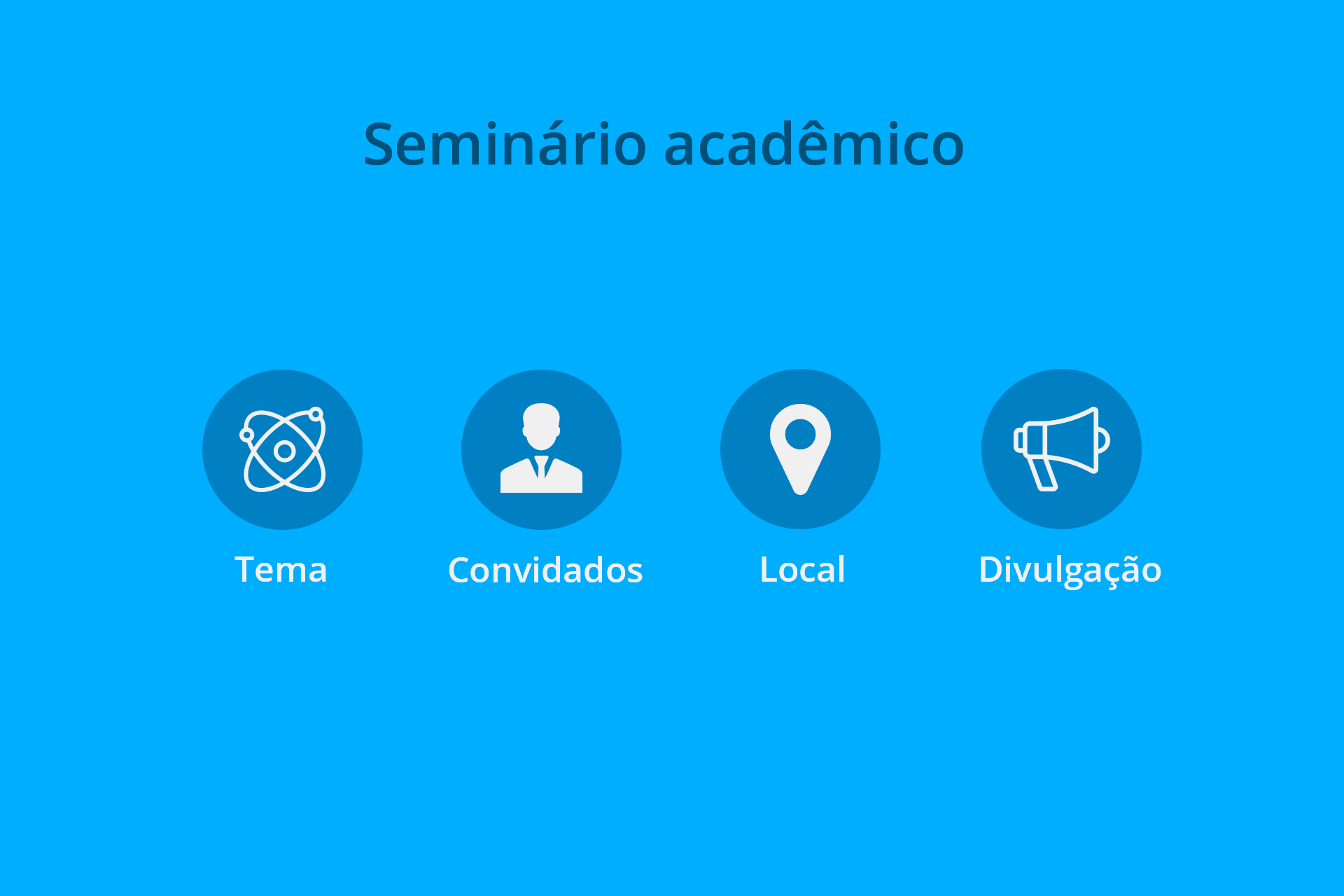
As you can probably tell by now, a seminar is a smaller-scale event. So it’s a bit simpler to organize.
But it all depends on your goal!
For example, if you want, your seminar can include paper submissions and presentations.
1. Think about the topic
The first thing to think about together with your team is choosing the topic.
That’s because it will guide your entire seminar: from choosing speakers, to invitations sent, all the way to promotional campaigns.
But that choice should take your audience into account.
So you should think about who your target audience is, which topics appeal to them, and why they should attend your event.
You also need to know your audience’s level of knowledge about the topic. After all, they need to follow along and take part in the seminar’s discussion.
Finally, align your event’s objective with your audience’s expectations and you’ll have the perfect topic for your seminar.
2. Choose your speakers
As I mentioned, a seminar usually has one or two guest speakers presenting the topic.
In that case, their profile will depend on the event’s goal.
For example, some seminars have the students themselves as presenters. They’re usually chosen through paper submissions, and those approved present their projects.
However, in scientific seminars it’s common for guests to be experts in the subject presented.
To choose them, you should:
- Look for speakers who best match your audience’s expectations;
- Check academic profiles (like Lattes) and also look for other related researchers;
- Search for professionals on social media, like LinkedIn;
- Rely on the help of speaker agencies;
- Ask other institutions or similar events for references.
Remember to choose your speakers in advance and lock in their participation in the event early on, since many of them tend to have packed schedules!
3. Research the ideal venue for the event
While planning your event, you need to choose the date, time and venue. This is also essential for formalizing the invitation to your speakers.
Just keep a few important points in mind:
- Avoid holidays and the same day as other major similar events;
- Choose the best time for your audience;
- Naturally, a seminar is an event with an audience. It’s usually held in a space like an auditorium, since that makes it easier for attendees to follow the presentation;
- Your event can be online or hybrid. In that case, having a platform for online streaming is important.
4. Promote your event
Finally, don’t forget that without the right promotion, your event won’t be known or sought out by attendees.
So talk with your team and put together a calendar for the event’s marketing activities.
You should also consider including email marketing in your promotion strategy, since it can be great for your outreach.
You can also develop a social media plan focusing on points like:
- Which social networks you’ll use;
- The types of posts you’ll publish;
- A posting calendar;
- Who will be responsible for communications.
To get started, you can count on Even3’s Marketing Kit for an editable publishing calendar and topic suggestions.
In the end, organizing an academic seminar doesn’t have to be complicated, right?
By following these tips and understanding more about how this type of event works, it becomes much easier to get your idea off the ground and put your plan into practice.