
You’re organizing an event with all the care in the world to make sure everything goes right!
But have you stopped to think that accidents can happen? That worry doesn’t have to keep you up at night.
Good event planning should already be prepared to deal with the unexpected. That’s why event insurance can be essential.
With it, you can focus on the tasks needed to reduce every risk and trust the insurance coverage for whatever is beyond your control.
Want to know if this is the right option for you? Check out:
- What is event insurance?
- Main benefits
- Which event insurance should I get?
- When should I get insurance?
- Who regulates events?
What is event insurance?
Event insurance is coverage that protects organizers from major financial losses and damages. These can be caused by accidents or other incidents.
Basically, it can save you a lot of headaches and unexpected trouble! It also covers situations such as:
- Damage to the venue’s property
- Repair costs
- Accidents
- Lawsuits and compensation claims
- Material damage, such as theft
What type of event should have insurance?
Insurance is not required by law, but it’s extremely necessary in some cases.
For example, large events, like concerts, are subject to laws that hold organizers liable for any damage that occurs during the event.
In these cases, insurance can help protect the organizer from lawsuits.
Also, any event with a large number of attendees, or a medium to large structure, can benefit from accident coverage offered by insurance.
After all, even if you ensure the venue’s safety, it’s important to protect yourself from third-party actions, like someone falling and getting hurt.
In an environment with a lot of people, it’s difficult to fully control and guide the actions of attendees and even the event staff.
Why get event insurance? Main benefits
As mentioned, insurance has several benefits. They include:
- Preparedness for the unexpected
- Increased credibility for the event
- Coverage and full support in case of accidents
- Safety for organizers and attendees
- Easier problem resolution
- Avoiding legal issues
- Savings on financial resources
Which event insurance should I get?
When getting insurance, you’ll deal with two types of coverage: Comprehensive Risk Insurance and General Liability Insurance.
Your choice between the two will depend on your event’s needs. Learn about the options:
General Liability Insurance
This is the most comprehensive type of insurance.
It protects the organizer from property damage and bodily harm to third parties, and can even extend coverage to protect the organizer as well.
Since it’s a very broad plan, it can cover several cases:
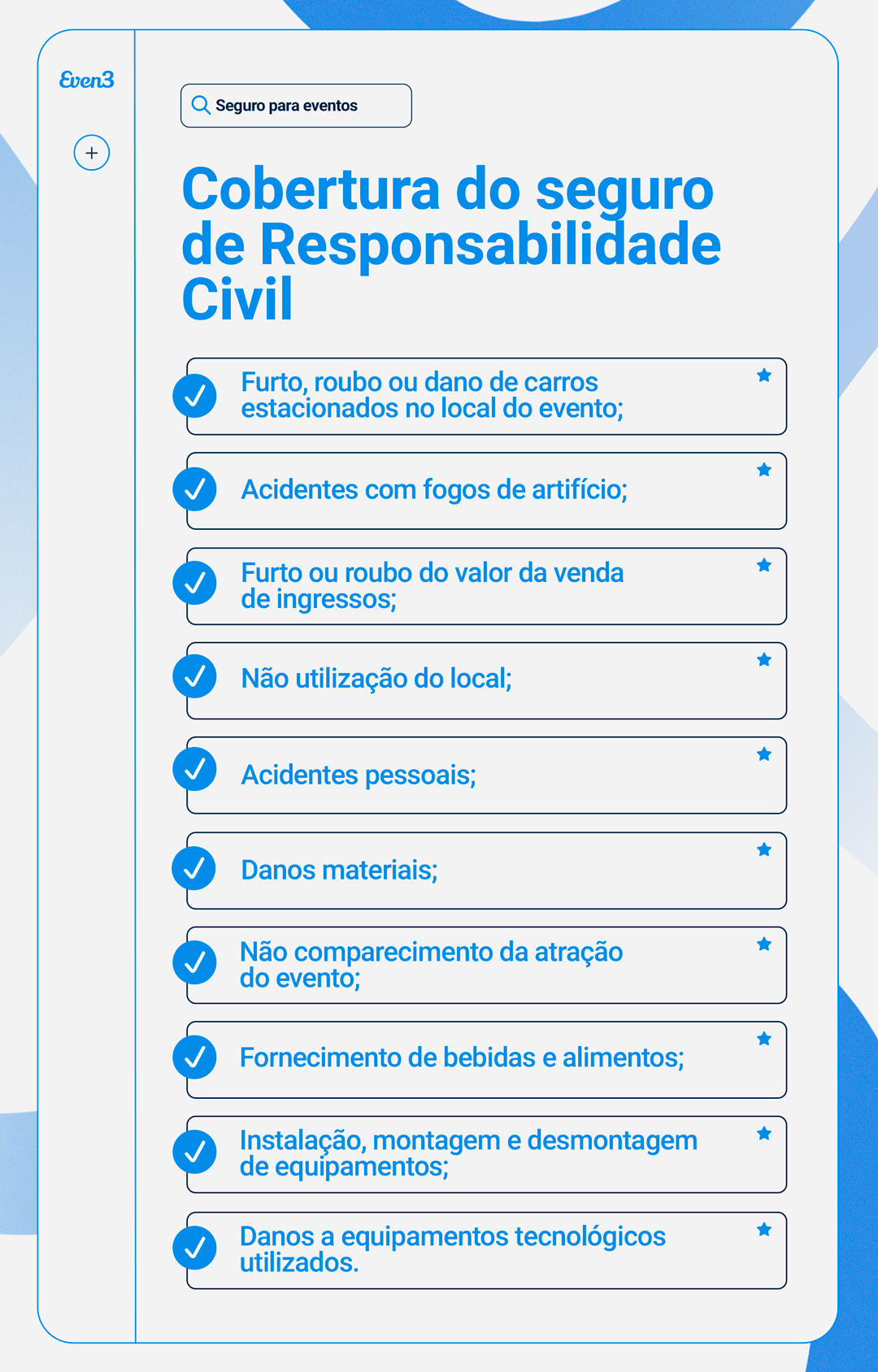
In these cases, some coverage options can be added or removed from the service.
Comprehensive Risk Insurance
Speaking of coverage that can be added, it’s common for Comprehensive Risk Insurance to be added on top of General Liability Insurance.
That’s because this type of insurance is much simpler.
In this case, Comprehensive Risk Insurance is meant to protect the organization only against loss and damage to property, such as the equipment used.
So it’s a more basic type of insurance and doesn’t cover moral or physical damages to attendees or the organizer.
How and when to get event insurance?
Event insurance is usually purchased during the planning phase.
That’s because the event should already have coverage from the start.
It’s also during this phase that you should research and get quotes. In other words, look for the insurance policy that fits your budget and makes sense for your event.
So remember to identify your event’s needs.
Map out the equipment you want to protect, the risks involved, the types of coverage needed, and the budget allocated for it.
Then, look for reliable insurers in the market and compare quotes.
In the end, your choice should result in an insurance policy, the document that formalizes the service agreement.
Who regulates events?
Finally, your event already ensures good safety for attendees. And regulatory bodies can confirm that!
It’s common for city halls, fire departments, and even health regulatory agencies to inspect certain events, depending on the laws that apply to them.
For example, in São Paulo, events with more than 250 people already require a permit that must be requested from the city hall.
That’s why, when creating your event, you should also pay attention to the legislation to protect yourself, your attendees, and your speakers.
In addition to permits, other obligations may apply to your event, such as data protection laws, copyright, and image and sound usage rights for speakers.