Have you noticed how much education has grown in the digital space? This is the ideal scenario to learn how to sell online courses and increase your profits!
According to higher education census data, the number of students in online courses has been growing steadily. Research revealed a significant rise in distance-learning enrollments in recent years.
It seems like it’s no longer possible to think about education without beloved online courses.
But do you want to know how to get started in this field? Today we’ll teach you everything about:
- Why sell online courses?
- Who can sell online courses?
- How to sell online courses in 5 steps;
- 3 platforms for selling online courses.
Why sell online courses?
As mentioned, online courses have grown a lot in recent years because they’re appealing. Among their main advantages are:
- Fast, practical learning;
- Certificates for attendees;
- Opportunity to specialize compared to in-person options.
So, you can see that online courses can be a promising option for education professionals, right? But not only for them! Many specialist professionals have also invested in online courses to teach and provide consulting.
Who can sell online courses?
With so many teaching options, online courses have taken over many fields. The people who create them are known as content creators, ranging from trained teachers to specialists who’ve also decided to pursue a teaching career.
That’s why an online course can be taught by anyone who has something to teach others, whether professional or personal experience.
However, you should be careful with your content, since it’s your product. And we don’t want the reputation of being a fake or misleading content creator, right? We want to avoid those too.
So, to teach your own online course, it’s ideal to have:
- Credentials, like experience, work in the field, or academic training;
- Teaching ability;
- Equipment for recording clear video and good audio.
How to sell online courses in 5 steps
1. Choose your niche
First, your online course should come from your own experience and what you can teach. This will define the niche you’ll work in.
But it’s worth thinking about what’s most sought after and could be most profitable for you. For example, you could be a language teacher ready to teach grammar courses, but people search more for writing courses.
So, if your goal is to attract a large audience, you can make adjustments and focus on the most sought-after content. Then, you’ll need to know your audience and what they’re looking for. For that, you can:
Analyze Google search trends
List the main topics you could teach in courses and check which ones are most searched for on Google. For that, you’ll need to use keyword research tools, like SEMrush, Keywordtool.io, Ubersuggest, or Google Trends.
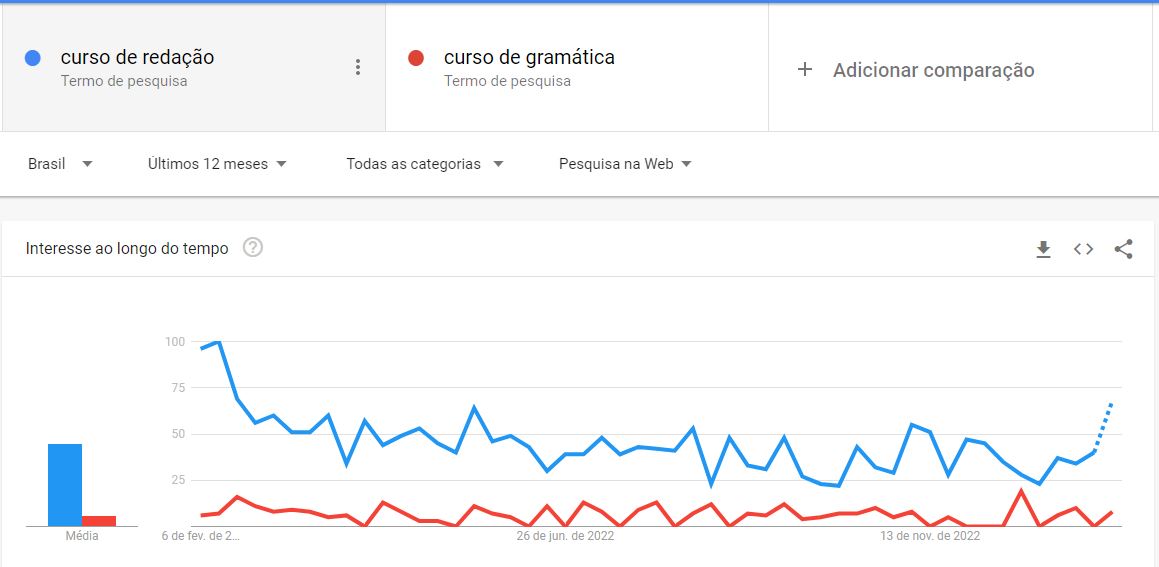
Example of a keyword search on Google Trends
This can indicate that more people are interested in the field, but it doesn’t guarantee it’s exactly the audience you’re looking for. Keep in mind that the higher the number of people searching for that content, the broader your audience will be, which might not be what some content creators are after.
Analyze the competition
See what professionals in the same field are doing and analyze their results. Remember to check whether the audience is the same one you want to reach, whether there’s a good response, or even whether there’s content missing that you could explore.
By exploring more specific content, you can reach a market niche that hasn’t been served yet, though you’ll have a much smaller target audience than the most searched topics. For example, using the case above, you could develop a writing course for a specific standardized exam or specialized language instruction for a particular test.
2. Know your target audience
Speaking of audience, this is a central point for choosing the best niche for your course. Discovering who your ideal audience is will guide your niche, how you’ll communicate, where you’ll promote the course, and much more.
For that, you need to conduct research, observe the competition and the market to define an ideal audience profile. Think about the characteristics that make them unique, like age, income range, gender, demographics, interests, and more.
The more specific your profile is, the more successful your communication with attendees will be. Also, once your course starts, you can run audience surveys and better understand who’s interested in your content.
3. Create your lesson plan
Now that you know what your audience needs, creating a lesson plan is essential. It will help you follow the class objectively, covering all the points needed for learning.
It can also be shared with students so they know everything that will be covered in the course. So, a lesson plan should include:
- Topic;
- Objectives;
- Content;
- Methodology;
- Schedule;
- Resources;
- Assessment method.
Remember: a well-structured lesson plan adds value to your course. So, try to show your differentiators, the topics that will be covered, how you’ll teach, and, above all, how many classes it will take.
After all, the number of study hours in a course is one of the biggest draws for those looking for certificates.
4. Time to produce the content
Finally, it’s time to produce the content! At this point, you’ll need some support tools, like:
Script
To help with this step, many people prefer to create scripts based on the lesson plan. They can take various formats, but basically contain the text that will be spoken in the video.
So, the script is a support tool to make sure you don’t forget content or misspeak. It also helps organize the content in the most educational and engaging way.
Necessary equipment
Recording video lessons is relatively simple because you’ll only need a camera and a microphone. In this case, you don’t need professional equipment — what matters is providing quality visuals and audio for learning.
In some cases, teachers also choose to edit the video, but it’s not required.
Tips for producing good content
- Position the camera at eye level and facing you — this is the position that keeps the focus on the teacher;
- Try to record in a well-lit place and avoid backlighting;
- Create an appealing set, since it helps connect with students;
- Be careful not to pick up noise, like blowing into the microphone or being in a windy environment.
The 3 best platforms for selling online courses
Udemy
Udemy is an online course platform present in many countries and well established in the market. It has courses in several languages, and many students see it as a reference for online learning, always looking for innovative courses there.
One of the platform’s strengths is that it runs marketing campaigns to promote courses. However, it charges for that! Although it’s free to host a course on Udemy, the fees charged for each purchase made on the platform can range from 3% to 75%.
Even so, Udemy offers secure payment methods that are valid internationally.
Hotmart
Hotmart is another well-known platform in the market, perhaps one of the most recognized. Although it’s a reference in the online course field, Hotmart creates solutions for digital products, with space even to sell e-books.
So, to sell your course there, you’ll need to invest in marketing to stand out among the many other options and not go unnoticed. However, one of Hotmart’s main strengths is that it has an Affiliate Program, where other people can promote your course and earn a share of the sales.
But remember, the platform also takes its share, since it charges fees ranging from 9.9% to 20% on each purchase.
Even3
Finally, Even3 is a Brazilian event management platform that has achieved worldwide reach. The platform is quite complete and goes beyond just hosting a course, since it offers essential services to automate the main steps of your course.
For example, there you can use various solutions to sell tickets, communicate with your students, and easily create and send certificates, plus much more.
In fact, one of the platform’s strengths is the automation of certificate creation and delivery — it can all be done with just one click!
Even3 is also one of the few free tools for courses that doesn’t charge for registration. For paid courses, the platform has one of the lowest fees in the market: always just 10% of the value of any sale on the platform.
So, how about starting to create your course right now? Give it a try for free!