
Did you know you can start receiving payments for your registrations in dollars, pesos, euros, and more? That’s all part of international events!
I love this type of event, but for it to be a success, it needs to be well executed.
In the rush to enjoy all the benefits of international events, many organizers forget important points, such as payment security, attendee integration, and simultaneous translation.
But you can do it differently! In this article, I’ll explain how to organize international events and give you tips on tools and features that will help you. Let’s get started!
Why organize international events?
Right off the bat, international events have benefits that many organizers aim for, such as growing their target audience.
But technology has brought even more reasons to hold international events, including:
- Easier organization for online events;
- The possibility of international networking;
- More visibility for your brand.
However, taking advantage of these benefits requires extra effort from the organization.
So have you stopped to think about the key points to watch when organizing an international event? Check out the next section!
How to organize an international event? 5 steps
1. Plan everything in advance: calendar and schedule
First, planning should be your main focus.
That’s because, in addition to the usual needs of any event, international events require some extra care upfront, starting with defining the agenda.
The calendar and schedule are crucial points during organization because they can be a somewhat more complex task.
After all, they’ll depend on an international agenda and will happen across different time zones, which can influence the format and timing of activities in your schedule.
To stay on track, you can monitor everything using our free spreadsheet and share it with your organizing team.
In practical terms, if your event is online, this is easier to manage.
However, live broadcasts will require effort both in aligning schedules and paying attention to time zones.
#Even3Tip: Pre-recorded broadcasts work very well for international events, since you don’t need to worry about time zones, schedules, or instability in the speaker’s connection.
To make the recorded video more engaging, you can collect questions from attendees in advance and ask the speaker to answer them on video, always saying the name of whoever asked.
Also, recorded videos can be made available for attendees to watch whenever they want, adding more value to your event.
2. Ensure several secure, international payment methods
As soon as you start organizing an international event, you’ll immediately run into a problem: different currencies.
In this case, it’s not just paying speakers and vendors that becomes a challenge, but especially attendee ticket purchases.
For this reason, your priority when organizing international events should be choosing the right online payment platform.
That is, an events platform that allows for automatic currency conversion when selling registrations, without any difficulty for you or your attendee.
This avoids paying conversion fees and taxes, making your tickets more accessible and easier to purchase, since the attendee will complete the whole purchase in their local currency.
For example, on Even3, when you create an international event, you’ll receive all payments in Brazilian reais, regardless of the attendee’s nationality and currency.
However, the currency shown to your attendees will depend on their payment country — exactly like what happens on international websites, you know?
This way, a Mexican attendee can easily buy a ticket to a Brazilian event, since the platform itself will convert Mexican pesos into reais.
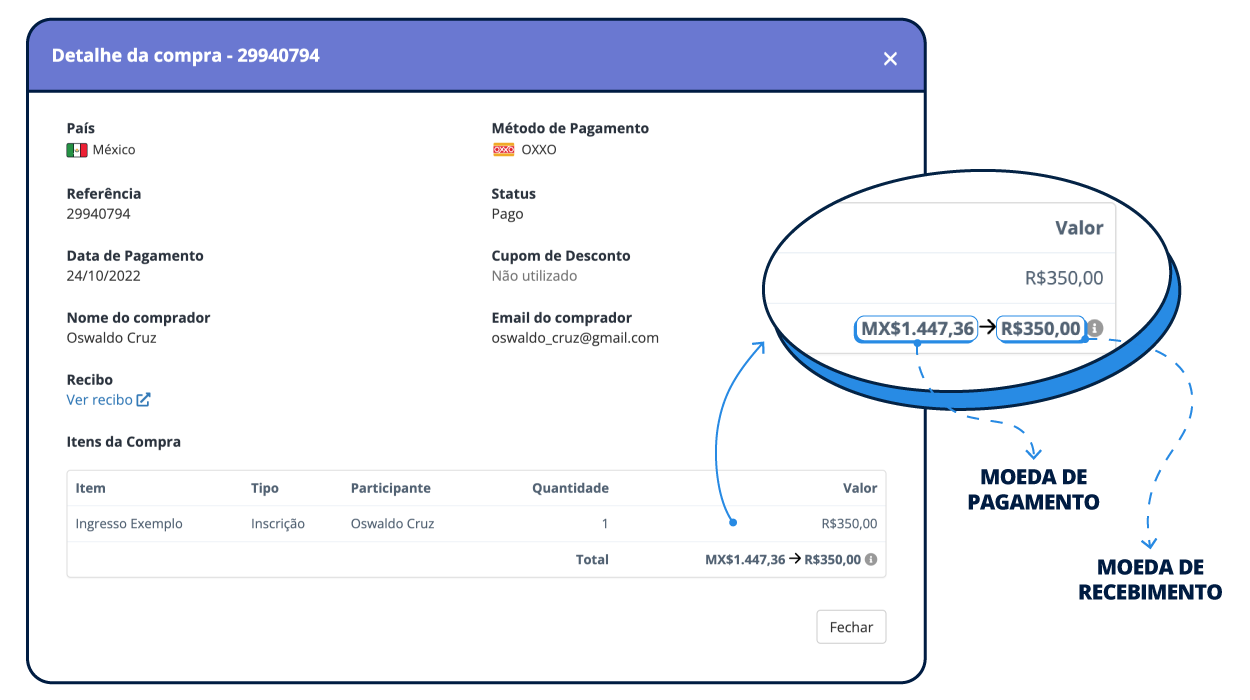
According to Ebanx, accepting only credit cards reduces the number of people who complete their purchase.
That’s because in Latin America alone, 60% of the population uses other payment methods, with local methods being the most popular, such as PIX in Brazil, Oxxo in Mexico, and Baloto in Colombia.
So offering local payment methods is a way to increase sales and reach a wider audience for your event, including people who wouldn’t have an international credit card to register.
3. Translate the main areas of your event
Now, to get to the registration payment step, it’s essential that your attendee can actually read the event’s information!
This isn’t just to complete a sale, but especially so they feel welcomed and have a good experience.
That’s why translation is essential! Both in your event’s texts and in the talks and the main areas attendees access.
Translation on the events platform
When we talk about translation in the main areas attendees access, we’re referring to the platform’s ability to translate certain areas of the event, such as the website and the registration payment area.
For example, on Even3, there’s a dedicated area for attendees where they can choose which language to view information in, with English, Portuguese, and Spanish available.
This way, they have direct access to the event schedule, submissions, certificates, and more, in the language they prefer.
Similarly, Even3’s translation module makes it possible to fully translate the event website, with up to three languages available, increasing your site’s reach.
Simultaneous translation at the event
Still on the topic of translation, speakers who don’t speak the event’s official language will likely need translation for their talks.
For this, you can opt for instant translation devices for in-person events, live interpreters, or subtitles on your recorded videos.
4. Be careful not to blow your budget
Speaking of hiring equipment, we’ve reached a very important point for organizers: the budget.
While organizing your international event, you’ll come across some specific needs, such as purchasing translation equipment, hiring an events platform, or even paying speakers.
In fact, it does require a bit more budget, but that’s also reflected in the price of your tickets.
So it’s essential to plan your finances well, balancing investments and infrastructure with a fair price for your tickets.
This way, you’ll have an idea in advance of how much you can spend in each area, without charging prices that are out of reach for your ideal attendee profile.
A good tip is to plan everything with our free finance spreadsheet.
After these points, you can also:
Look for sponsors
International events tend to be well regarded by large companies!
So take this chance to reinforce your event’s value and present sponsorship proposals to the right companies.
Price your tickets correctly
To get an idea of how much to charge for registration, consider pricing around 25% of the event’s original value and relying less on sponsorships in some cases.
5. Expand your promotion
Finally, we’re ready to start promoting! And let me tell you, the best part of international events is their reach.
In this scenario, working the right way, your marketing team can grow your event’s audience and sell even more tickets.
A good tip is to invest in paid ads on social media! That is, targeted content that can help you test new possibilities for promoting your event and take advantage of the results!
Go global like Even3
Once your international event is ready and well structured, how about putting it into practice on a global platform?
Even3 is a platform that helps organize events all over the world, offering support for multiple languages.
It covers more than 100 countries and, as a result, attendees from all over the world, with more than 100 available payment methods and dozens of accepted currencies, with conversions handled right within the platform.
Your event is also featured on Even3’s pages, in content for attendees, and on Google.